Compliance Is Not a Checklist, It Is a Stack: What Applies to Your Business Type and Industry in India
Two businesses in the same city can sell the same product and owe completely different filings. This is why compliance for every business type in India cannot be copied from a neighbour or a friend. This is Blog 1 of 2: it explains the Compliance Stack framework, the obligations for every business type, the industry layer, the nine blind spots that cost businesses the most, the true cost of a missed filing, and a one-page recurring calendar. Continue with Blog 2: One MDA, One Calendar, One Report Chain. Dates and thresholds are recurring standards; confirm each on the official portal every year because extensions and rule changes are common.
What is the mistake almost every owner makes?
A private limited company, an LLP and a sole proprietor each answer to different authorities. Yet most owners copy a neighbour's or a friend's compliance list.
The fix is to stop thinking of compliance as a list and start thinking of it as a stack of layers. Each layer adds obligations. You only know your full compliance load when you have checked every layer.
The Compliance Stack: five layers
| Layer | Question it answers | Examples of what it decides |
|---|---|---|
| 1. Entity | What legal form are you? | MCA filings, AGM, board meetings, ITR form |
| 2. Operation | What do you actually do? | Licences, packaged-goods rules, factory registrations, e-invoicing |
| 3. Industry | Which regulator watches your sector? | FSSAI, drug licences, SEZ or STPI reports, FEMA, RERA |
| 4. Size and place | How big are you and where? | GST frequency, tax audit, state registrations, PF and ESI |
| 5. Events | What just changed? | New director, new state, new hire, first export, turnover crossing a threshold |
Layers 1 and 2 are what most guides describe. Layers 3 to 5 are where businesses get caught.
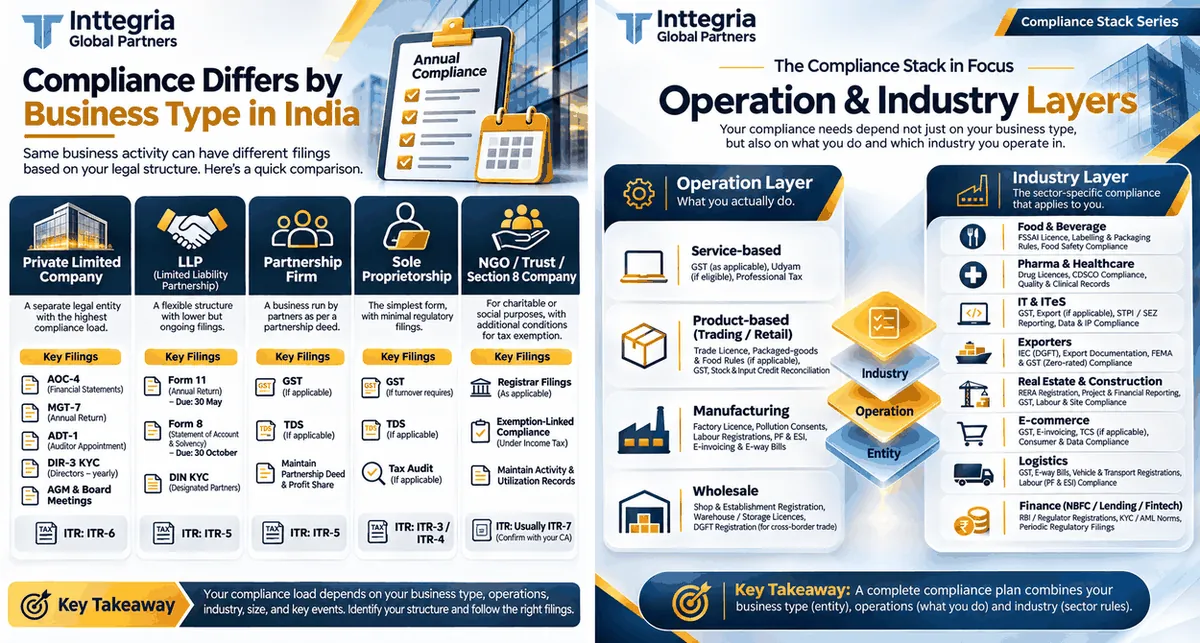
Layer 1: compliance for every business type in India
| Business type | Core annual obligations | Income tax return |
|---|---|---|
| Private limited company | Financial statements (AOC-4), annual return (MGT-7), DIR-3 KYC for directors, AGM, board meetings, auditor appointment (ADT-1) | ITR-6 |
| Public limited company | All private company filings plus wider disclosure and governance; listed companies also follow SEBI rules | ITR-6 |
| One Person Company (OPC) | AOC-4, shorter annual return (MGT-7A), DIR-3 KYC; generally no AGM | ITR-6 |
| LLP | Annual return (Form 11), statement of account and solvency (Form 8), DIN KYC for designated partners | ITR-5 |
| Partnership firm | No MCA annual filings; GST, TDS and income tax as applicable | ITR-5 |
| Sole proprietorship | No MCA annual filings; GST, TDS and tax audit if applicable | ITR-3 or ITR-4 |
| NGO, trust or Section 8 company | Registrar filings where applicable; exemption-linked compliance under income tax law | Usually ITR-7; confirm with your CA |
What to note for each business type
- Private and public companies: These carry the heaviest annual load. AGM for most companies is due by 30 September; AOC-4 within 30 days of the AGM; MGT-7 within 60 days; ADT-1 within 15 days; DIR-3 KYC by 30 September. Private companies generally need at least four board meetings a year, or two for small companies. Long non-filing can lead to striking-off and director disqualification. See annual compliance for private limited companies.
- OPCs: These are lighter, but the discipline is the same: statements, KYC and tax return on time.
- LLPs: There are two separate dates, Form 11 by 30 May and Form 8 by 30 October. Late fees accrue per day with no upper cap, so a missed LLP form becomes expensive quietly. Read more on LLP annual compliance.
- Partnership firms: There is no MCA filing, but remuneration and interest to partners must follow the deed and tax rules. Keep the deed and the working together.
- Sole proprietors: There is no MCA filing, but business income lands in the personal return. The main risk is mixing personal and business money, which distorts reconciliation and tax audit thresholds. This is the core of sole proprietorship compliance.
- NGOs, trusts and Section 8 companies: These have both registrar filings and exemption conditions. Losing exemption status costs far more than a late fee, so treat these filings as top priority.
- Every type that is GST-registered or deducts TDS: These file regular returns. Turnover growth can move you from quarterly to monthly filing without warning.
Layer 2: obligations by operation type
Most businesses combine one entity type with one operation type. Check both.
| Operation | What you may need beyond entity filings |
|---|---|
| Service based | GST where turnover requires, Udyam registration if eligible, professional tax |
| Product based (trading, retail) | Trade licence, packaged-goods and food rules, GST, stock and input credit reconciliation |
| Manufacturing | Factory licence, pollution consents, labour registrations, PF and ESI, e-invoicing and e-way bills |
| Wholesale | Shop and establishment registration, warehouse or storage licences, DGFT registration where trading across borders |
Example: a private limited manufacturer owes the company filings in the entity table and the factory, pollution and labour registrations here. Neither list is complete alone.
Layer 3: industry-wise compliance in India
This layer is where a general guide stops and a specialist starts. The table lists commonly relevant items by industry. It is a prompt for your own check, not an exhaustive list; confirm applicability with your professional. For licences and registrations in detail, see registrations and licences by industry.
| Industry | Commonly relevant regulatory items |
|---|---|
| Manufacturing | Factory licence, pollution consents, labour registrations, PF and ESI, e-invoicing, e-way bills |
| Food and beverage | FSSAI licence or registration, trade licence, fire and local permits, packaged-goods labelling |
| Pharma and healthcare | Drug licences, clinical establishment registration, bio-medical waste authorisation where applicable |
| IT and ITeS | SEZ or STPI periodic reports where applicable, GST treatment of export of services, transfer pricing for related-party transactions |
| Exporters | Import-export code, export documentation, foreign exchange reporting under FEMA, GST treatment of exports |
| Real estate and construction | RERA registration and periodic updates, labour and contractor registrations, GST on works |
| E-commerce and marketplaces | GST registrations by state, tax collection rules for marketplaces, consumer and product-labelling rules |
| Education and non-profit | Trust or society filings, exemption-linked income tax compliance, affiliation requirements |
| Logistics | Transport permits, e-way bills, vehicle and driver documentation |
| NBFC, fintech and finance | RBI directions and returns, KYC and reporting obligations |
Operation and industry together: an exporter that manufactures sees the factory items and export documentation and FEMA reporting. The stack adds, it never replaces.
Layer 4: size and place
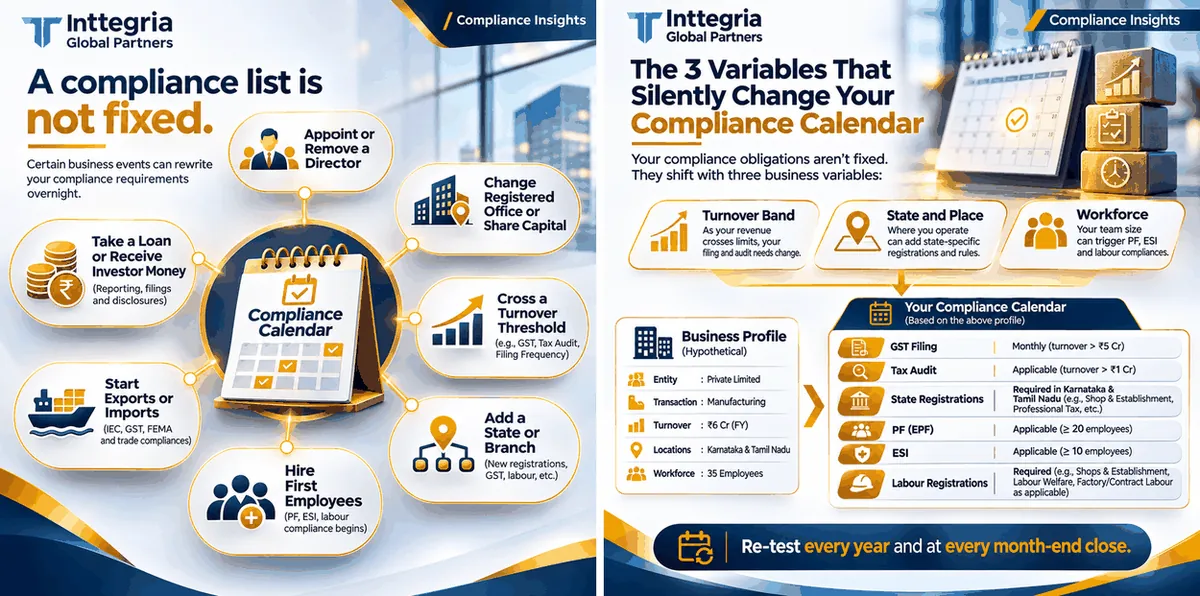
Three variables silently change your calendar:
- Turnover band: This can change GST filing frequency, trigger tax audit and make the GST annual return applicable above its filing threshold.
- State: This changes professional tax, shop and establishment, and GST registrations. A second state is a new set of registrations.
- Workforce: This triggers PF and ESI and labour registrations once the relevant thresholds are met.
Re-test these every year and at every month-end close, not just when you remember.
Layer 5: events that rewrite your compliance list
A compliance list is not fixed. These events change it overnight:
- Appointing or removing a director (the director list in annual forms must match)
- Changing registered office or share capital
- Crossing a turnover threshold
- Adding a state or branch
- Hiring your first employees
- Starting exports or imports
- Taking a loan or investor money
If nobody owns the job of updating the profile when an event happens, the calendar is already wrong.
The nine blind spots that cost the most
Most losses come from a few items that look routine until missed.
- Input tax credit the supplier has not reported: Found only by matching your purchase records against supplier-filed data, not by checking your own books.
- GSTR-1 and GSTR-3B that disagree: The system sees the gap before you do.
- Turnover crossing a threshold unnoticed: Filing frequency or required filings change.
- Auditor appointment not filed: The audit starting is not the same as the appointment being filed.
- Director KYC missed for passive directors: A deactivated DIN can affect every company the director serves.
- TDS under the wrong section, rate or PAN: The same error repeats on every payment for a year.
- Annual forms filed with stale data: Director list, registered office or share capital changed but forms were not updated.
- MSME dues not reported where applicable: Easy to forget because it appears only twice a year.
- Income tax and GST that do not tell the same story: Turnover and expenses should reconcile after permitted differences; a mismatch is an early scrutiny trigger.
The Mismatch Triangle
The government cross-checks your records against each other. Three comparisons matter most:
- Sales: your GST return against what your buyers report.
- Deductions: your TDS against the Annual Information Statement.
- People: your payroll against PF and ESI contributions.
A difference in any corner is usually noticed by a system before it is noticed by you. A business that reconciles the triangle every month rarely meets a surprise notice.
What is the true cost of non-compliance?
Visible costs. Late GST returns attract daily fees and interest on unpaid tax. Late TDS deposits attract interest, and late TDS returns attract daily fees. Late MCA forms attract daily fees per form. Continued non-filing can lead to striking-off and director disqualification.
Invisible costs, often larger:
- A late income tax return means eligible business losses cannot be carried forward to set off future profits.
- Blocked input credit and delayed refunds lock up working capital.
- Banks, large customers and tender authorities read your compliance history, so a poor record slows loans and deals.
Hypothetical example: a manufacturer claims INR 10 lakh of input tax credit on invoices its suppliers never reported. A year later a notice arrives, the credit is reversed, interest is added at an indicative 18 to 24 percent a year depending on the default, and a penalty may follow. The company spends weeks of staff time and professional fees on the reply while the working capital is locked up. The original saving from a quick, cheap filing was a few thousand rupees.
The compliance calendar India businesses can keep on one page
Confirm every date on the official portal each year.
| Due date | What is due | Applies to |
|---|---|---|
| 7th of each month | TDS deposit for previous month | Anyone deducting TDS |
| 11th of each month | GSTR-1 | Monthly GST filers |
| 15th of each month | PF and ESI contributions | Employers |
| 20th of each month | GSTR-3B | Monthly GST filers |
| 31 May, 31 July, 31 October, 31 January | Quarterly TDS returns | TDS deductors |
| 15 June, 15 September, 15 December, 15 March | Advance tax instalments | Taxpayers liable for advance tax |
| 30 May | Form 11 | LLPs |
| 30 June | DPT-3 | Companies where applicable |
| 30 September | AGM for most companies; DIR-3 KYC | Companies and directors |
| 30 October | Form 8 | LLPs |
| 31 October | Income tax return where tax audit applies | Audit cases |
| 31 December | GSTR-9 | Businesses above the threshold |
| Within 15, 30 and 60 days of the AGM | ADT-1, AOC-4, MGT-7 | Companies |
Where Inttegria fits
Knowing the stack is step one; running it all year is the hard part. ONE MDA, delivered by Inttegria on the IGP framework, builds each client's compliance list from a profile (entity, operation, industry, turnover band, state, workforce, cross-border activity), places every obligation on one calendar with an owner, and reports status monthly. The full operating model, the annual compliance service and the report chain are in Blog 2.
Start with your stack: see the Compliance Calendar service, ask for an O2C Report to see where you stand today, or talk to an MDA through ONE MDA. For the monthly, quarterly and annual checks with owners and evidence, read the company compliance checklist.
Frequently asked questions
Does every business need the same compliance?
No. Entity, operation, industry, size, state and events together decide your list.
Do sole proprietors file with the MCA?
No. They file income tax, plus GST and TDS where applicable.
What happens if I miss a filing?
Fees and interest begin the day after the due date. Continued default can bring further penalties, and a company can face striking-off and director disqualification.
How do I know my industry layer?
Ask which regulator can inspect or licence your activity. Each regulator is a possible layer.
How often should I recheck my stack?
Every year, at every month-end close, and every time one of the five events happens.
This article is general information, not legal or tax advice. Dates and thresholds are recurring standards, so confirm each on the official portal every year because extensions and rule changes are common.
Want a dedicated accountant for your business?
Meet the MDA service, or tell us what you need and we will come back with a plan.