The One-MDA Compliance Checklist: Accuracy, Maximum Support and What People Fail to Notice
Most companies do not fail compliance because they are careless. They fail because they miss a deadline, file a form with stale data, or assume a check happened when it did not. A written checklist fixes much of this, but only if someone runs it every month and can prove it was done.
This guide sets out the company compliance checklist that ONE MDA runs, how it works for accuracy, the points people most often miss, the regulatory items that vary by business type, and the reports you receive as a result. For how the same checklist sits on one calendar and one report chain, read One MDA, One Calendar, One Report Chain.
What is on the One-MDA compliance checklist?
ONE MDA runs the company compliance checklist in three rhythms. Every task has an owner and a due date, and each one leaves evidence behind.
Monthly checks keep the routine running. Each month, the named accountant confirms that the books are complete, reconciles bank, vendor and customer balances, and prepares the GST and TDS workings. The TDS deposit is checked against the 7th, GSTR-1 against the 11th, GSTR-3B against the 20th, and PF and ESI against the 15th. The monthly MIS is delivered by working day 15.
Quarterly checks cover the items that come round every three months: the quarterly TDS returns, the advance tax instalments, and a review meeting with you to go through cash, the MIS and any open exceptions.
Annual checks cover the company's yearly filings: the AGM, board meetings, the auditor appointment, DIR-3 KYC for directors, the financial statements, the annual return, the DPT-3 return of deposits where it applies, the income tax return, and the GST annual return.
The table below shows the core company checklist. The dates are standard recurring dates, and each must be confirmed on the official portal each year.
| Check | Frequency and due date | Owner | Evidence you receive |
|---|---|---|---|
| Bank, vendor and customer reconciliation | Monthly, before the GST return | ONE Dedicated Accountant, reviewed by a second person | Reconciliation statements |
| TDS deposit | 7th of the following month | ONE Dedicated Accountant | Challan |
| GSTR-1 and GSTR-3B | 11th and 20th of the following month | ONE Dedicated Accountant, then your approval | Acknowledgement |
| PF and ESI | 15th of the following month | ONE Dedicated Accountant | Payment confirmation |
| Monthly MIS and review | By working day 15 | ONE Dedicated Accountant, then delivery lead | MIS pack with commentary |
| Quarterly TDS returns | 31 May, 31 July, 31 October, 31 January | ONE Dedicated Accountant | Return acknowledgement |
| Advance tax | 15 June, 15 September, 15 December, 15 March | ONE Dedicated Accountant | Challan and computation |
| AGM and board meetings | AGM by 30 September; board meetings at least four a year for most companies | Company secretary or licensed partner | Notice, minutes, attendance |
| DIR-3 KYC for each director | By 30 September | ONE Dedicated Accountant, with director action | KYC acknowledgement |
| Auditor appointment (ADT-1) | Within 15 days of the AGM | Licensed partner | Filing receipt |
| Financial statements (AOC-4) | Within 30 days of the AGM | Licensed partner, after your approval | Filing receipt |
| Annual return (MGT-7 or MGT-7A) | Within 60 days of the AGM | Licensed partner, after your approval | Filing receipt |
| DPT-3 | By 30 June, where applicable | Licensed partner | Filing receipt |
| Income tax return | 31 October where a tax audit applies | ONE Dedicated Accountant, then licensed partner | Acknowledgement and tax summary |
| GST annual return | 31 December, above the filing threshold | ONE Dedicated Accountant, then licensed partner | Acknowledgement |
How do accuracy and maximum support work?
Accuracy is not a single check at the end. It is built into the process in four ways.
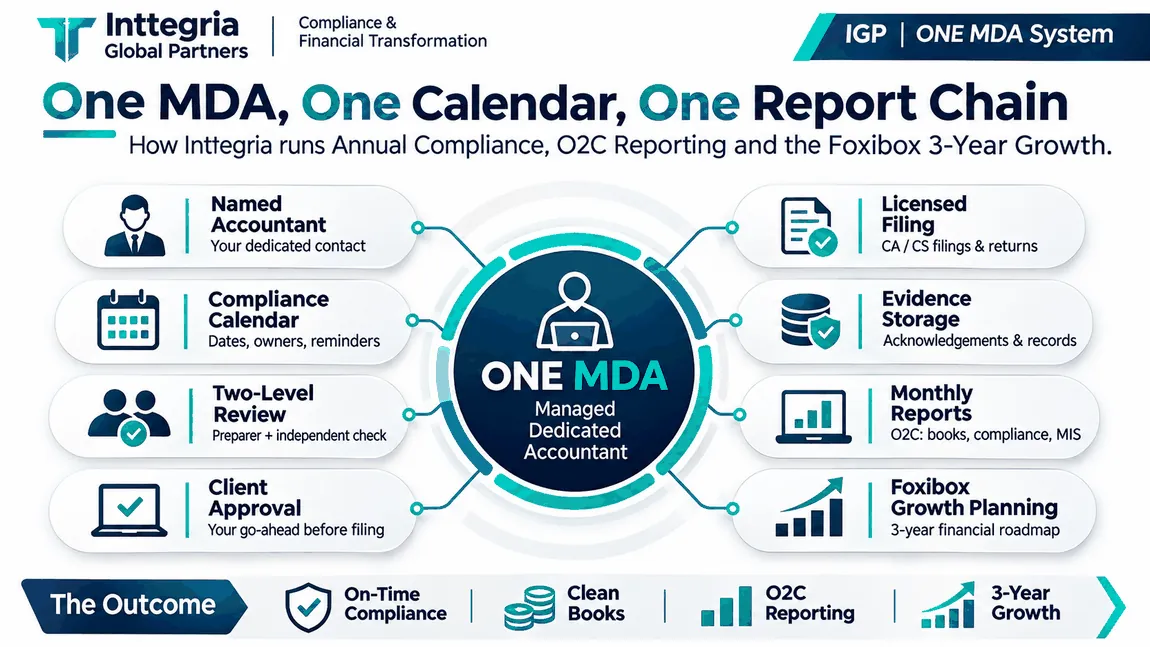
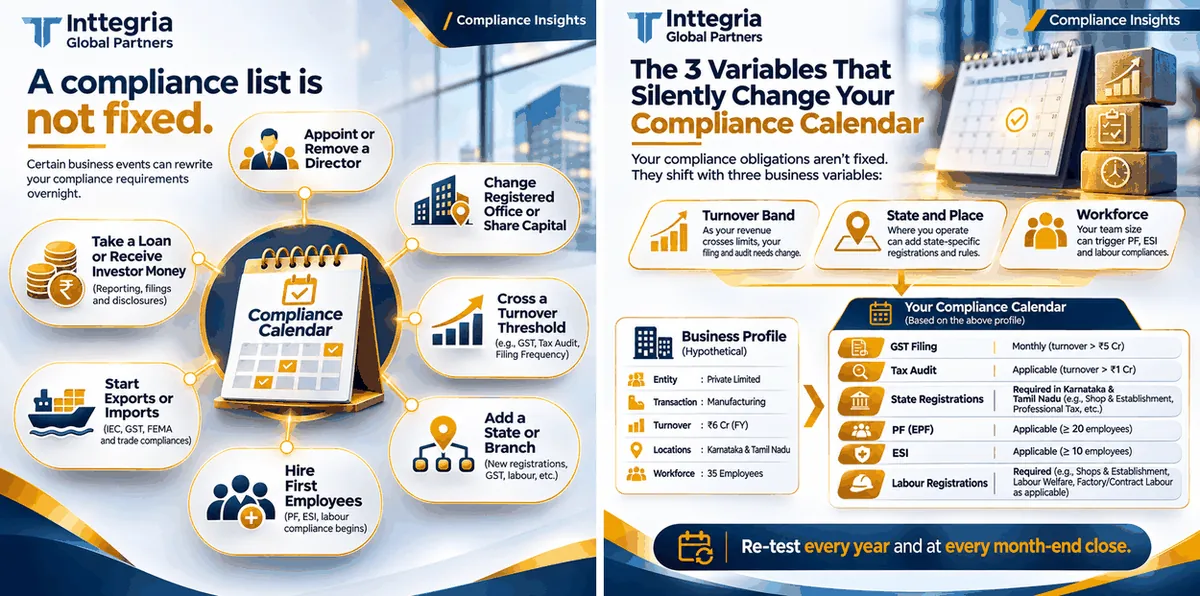
- The right starting point: The checklist is built from your profile, not a generic template, so the company sees only the obligations that apply. A private limited company with a manufacturing unit sees both the company filings and the factory, pollution and labour items. A company with no GST registration does not see GST returns.
- Two-level review: Every deliverable passes a preparer check and an independent reviewer check. The reviewer is not the person who prepared the work. This catches the errors that a single person tends to miss, such as a sales figure that does not match between two returns.
- Your approval before filing: Nothing is submitted until you have approved it in writing. You review the return summary and the figures behind it, not just the acknowledgement after the event.
- Maximum support: You have a named accountant, who knows your business and has a back-up for when they are away. Behind them are reviewers, a licensed partner for statutory sign-offs, and an expert desk for industry, legal and secretarial questions. If a question needs a specialist, the accountant escalates it, so you do not have to find the right person yourself.
Maximum support does not mean more noise. You hear about a problem when it matters, through a proactive alert on a deadline, a notice, a mismatch or a cash risk, rather than a flood of reminders.
What do people fail to notice in compliance?
Most compliance losses come from a small number of items that look routine until they are missed. These are the ones the checklist is built to catch.
- Input tax credit that the supplier has not reported: Credit claimed on invoices that a supplier has not reported is the most common GST problem. It is found by matching your purchase records against the data suppliers file, not by checking your own books alone.
- GSTR-1 and GSTR-3B that do not agree: The sales declared in GSTR-1 should match the tax paid in GSTR-3B. A gap between them is visible to the system before you see it, so it is checked every month.
- Turnover that crosses a threshold: A growing company can move from one GST filing frequency to another, or from one set of filings to another, without anyone noticing. The checklist re-tests your turnover band each year and at each month-end close.
- The auditor appointment that is not filed: The appointment of the first auditor is a filing in its own right. Companies often treat the audit as done once the auditor starts work, and miss the filing that records the appointment.
- Director KYC that is due even when nobody is active: Every director must complete DIR-3 KYC each year, including directors who are not involved in day-to-day running. A missed KYC can lead to the director's DIN being deactivated, which affects every other company that director serves.
- TDS deducted under the wrong section, rate or PAN: These errors are often repeated for a whole year before they are noticed, because the same mistake appears on every payment.
- Annual forms that are filed with stale data: Financial statements and the annual return must match the books and the board's records. If the director list, registered office or share capital has changed during the year, the forms must reflect it.
- The MSME dues that need reporting: Companies that owe money to micro and small suppliers may need to file MSME-1 returns, where applicable. This is easy to forget because it appears only twice a year.
- The income tax items that need the same data as GST: Turnover and expenses in the income tax return must agree with the GST returns, after accounting for permitted differences. A mismatch is one of the first things a scrutiny notice points to.
How does the checklist change by business type?
The company checklist sits on top of the rules for your business type. The table below shows where the main differences are.
| Business type | Yearly compliance points to watch |
|---|---|
| Private limited company | AGM by 30 September for most companies; AOC-4 within 30 days of the AGM; MGT-7 within 60 days; ADT-1 within 15 days; DIR-3 KYC; board meetings; income tax return |
| Public limited company | All private company points, plus wider disclosure and governance. Listed companies also follow SEBI obligations |
| One Person Company | Generally no AGM; financial statements; shorter annual return (MGT-7A); DIR-3 KYC; income tax return |
| LLP | Annual return (Form 11) by 30 May; statement of account and solvency (Form 8) by 30 October; income tax return; DIN KYC for designated partners |
| Partnership firm | No MCA filings; firm's income tax return; partner remuneration and interest in line with the deed |
| Sole proprietorship | No MCA filings; proprietor's income tax return; GST and TDS where applicable |
| NGO, trust or Section 8 company | Registrar filings where applicable; exemption-linked compliance under income tax law |
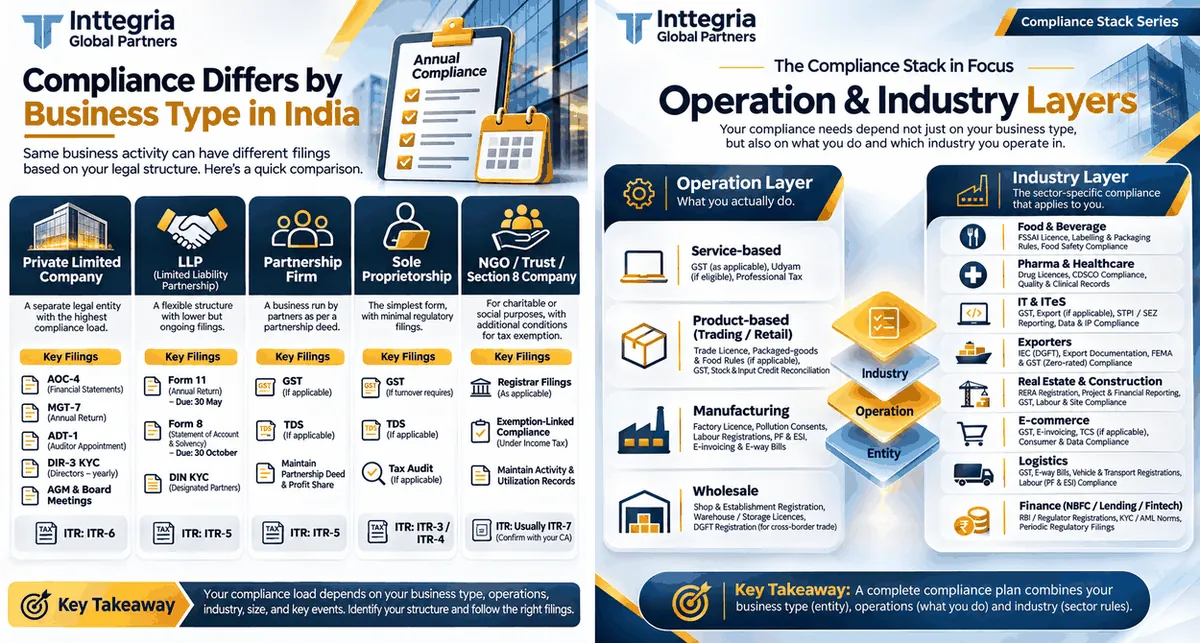
A regulatory point that is easy to miss is that the same activity can trigger different rules depending on the business type. For example, a private limited company that distributes dividends has different filing points from an LLP that distributes profits to partners. The checklist is set by the business type before any filing is scheduled.
For industry-specific items, the checklist adds the relevant layer. A manufacturer adds factory licences, pollution consents and labour registrations. An exporter adds export documentation and FEMA reporting. An IT or ITeS business adds SEZ or STPI periodic reports where applicable. If you are still choosing a structure, see registration services first.
Which reports does the checklist produce?
The checklist is only useful if you can see what it has produced. ONE MDA produces a set of reports from the same data, so you are not chasing information across different people.
| Report | When you receive it | What it shows |
|---|---|---|
| Monthly MIS pack | By working day 15 | Profit and loss, balance sheet, cash position, cost monitoring and commentary |
| Compliance status report | Monthly | Each filing marked as filed, awaiting approval, in review, data awaited, scheduled or planned, with owners and due dates |
| Exceptions log | Monthly | Mismatches, pending items and risks raised, with the action taken and who owns the next step |
| Reconciliation summary | Monthly | Bank, vendor, customer, GST and TDS reconciliations, with unresolved items explained |
| Quarterly review pack | Each quarter | Scorecard of on-time filings, open exceptions, cash trend and decisions taken |
| Annual compliance closure report | At the end of the year | Every annual filing with its acknowledgement, the open items carried forward, and the calendar for the next year |
| Data room index | On request, at any time | Acknowledgements, working papers and approvals, in one secure place |
The annual closure report deserves particular attention. It is the record a bank, investor or tender authority is likely to ask for. It shows that each filing was done, approved and closed, rather than simply submitted. To see where your company stands today, ask for an O2C Report.
Frequently asked questions
Is this checklist enough to run compliance on its own?
The checklist sets out what must happen and when. Running it well needs a named owner, a reviewer and an approval step, which is what ONE MDA provides.
Who signs the statutory filings?
Licensed professionals sign and file the statutory returns and forms, after your approval. Inttegria provides the data layer, the checklist and the coordination.
How often do I see the reports?
The monthly MIS and compliance status report arrive every month. The quarterly review pack arrives each quarter, and the annual closure report at year-end.
What if my company's details change during the year?
The profile is updated, and the checklist is re-run for the affected items. A change in directors, registered office, turnover band or state is reflected in the next cycle.
This guide is general information, not tax, legal or investment advice. Dates are standard recurring dates, so confirm each one on the official portal every year.
Want a dedicated accountant for your business?
Meet the MDA service, or tell us what you need and we will come back with a plan.