Registrations, Licences and Compliance by Industry in India
What Your Business Needs Beyond the Incorporation Certificate
Incorporation gives your business a legal identity. It does not, by itself, permit you to operate in every sector. Most industries require additional registrations, licences or approvals, and the list changes with your activity, location and size.
Four Layers of Registration
It helps to think of business registration in four layers:
| Layer | Purpose | Examples |
|---|---|---|
| Entity registration | Creates the legal business | Company, LLP, OPC, partnership, proprietorship |
| Tax registration | Enables lawful billing and tax payment | PAN, TAN, GST, professional tax |
| Compliance registration | Covers employees, local presence and size-based schemes | Shops and Establishment, EPFO, ESIC, Udyam (MSME) |
| Industry licences | Permits specific regulated activities | FSSAI, factory licence , drug licence , RBI, RERA, import-export code |
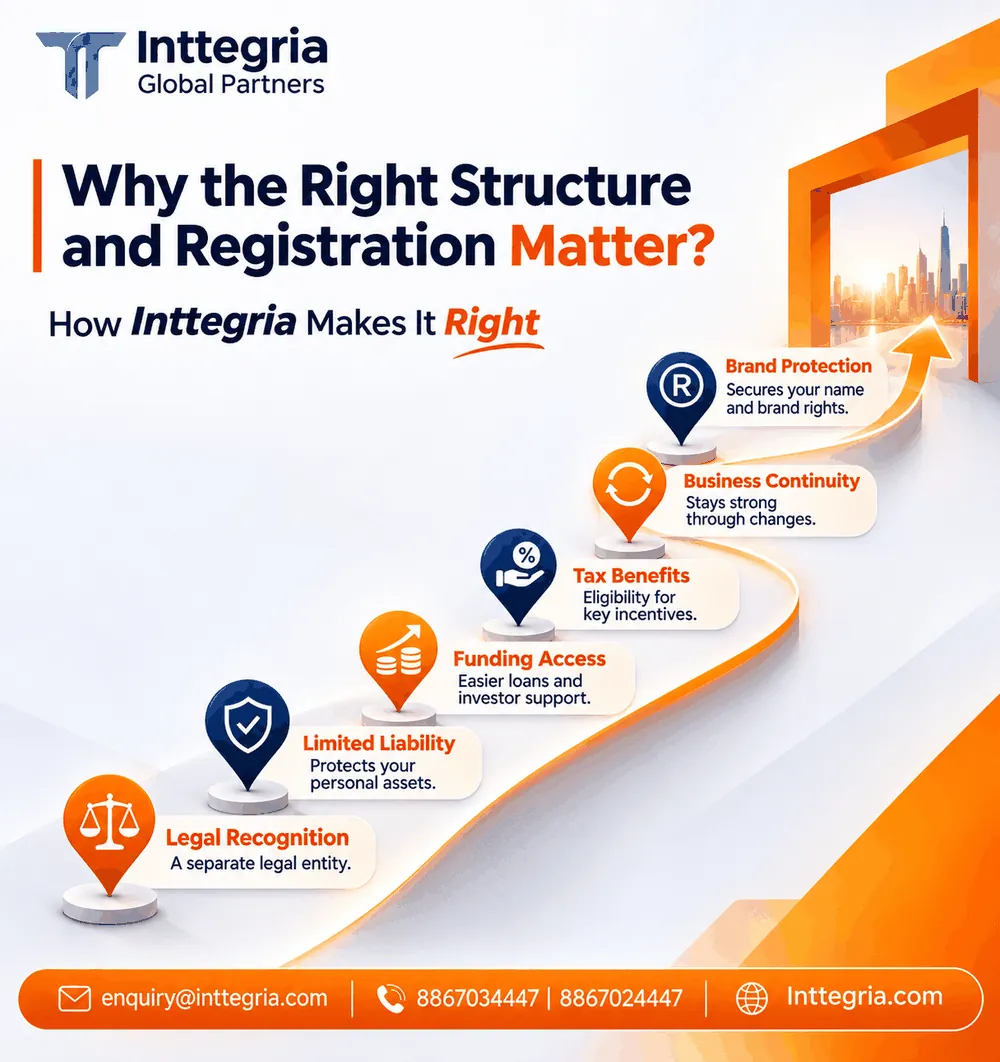
Brand protection (trademark registration) runs alongside all four layers, and is worth doing early.
Registrations Most Businesses Should Consider
- PAN and TAN: Needed for tax identity and for deducting tax at source.
- GST registration: Mandatory beyond turnover thresholds, and also in certain cases regardless of turnover, such as inter-state supply of goods in many situations and e-commerce operators. Voluntary registration can help with input tax credit and with dealing with larger clients.
- Shops and Establishment registration: State-level registration for commercial premises, with rules varying by state.
- Udyam (MSME) registration: Useful for access to MSME-linked benefits, credit schemes and vendor preference.
- Professional tax: Applicable in several states, for both employers and professionals.
- EPFO and ESIC: Applicable once employee numbers and wage levels cross the prescribed limits.
- Trademark: Protects your brand name and logo against copying. Registration is class-based, so the correct class matters.
- DPIIT Startup Recognition: For eligible startups, it opens access to certain tax and regulatory benefits.
- Bank account and accounting set-up: Clean books from the first week make every later filing simpler.
Industry-Wise Registrations and Licences
The table below is a guide to what commonly applies. Exact requirements depend on your state, scale and specific activity, so treat it as a starting point for a conversation rather than a final checklist.
| Industry | Commonly required registrations and licences | Compliance and legal points to plan for |
|---|---|---|
| IT and software services | Company or LLP, GST, Shops and Establishment, Udyam, trademark; DPIIT recognition if eligible | IP assignment in employment and client contracts, data protection and confidentiality terms, export-of-services documentation |
| Manufacturing | Company registration, GST, Udyam, factory licence , pollution control consent from the state board, fire safety clearance; BIS certification for notified products | Factory and labour law compliance, EPFO and ESIC, waste handling, safety audits |
| Food and restaurants | FSSAI licence or registration, local trade or health licence , fire safety clearance, GST; liquor licence where applicable | Food safety standards, hygiene audits, signage and labelling, music licensing for public performance |
| Trading, import and export | Importer-Exporter Code (IEC), GST, bank AD code registration, export promotion council membership where relevant | Customs documentation, foreign exchange rules, product-specific import or export restrictions |
| E-commerce | GST (often mandatory irrespective of turnover), trademark, seller or marketplace onboarding; FSSAI or legal metrology registration depending on products | Consumer protection rules for e-commerce, return and refund policies, privacy policy, seller agreements |
| Healthcare and clinics | Clinical establishment registration where applicable, professional council registration, biomedical waste authorisation , drug licence for pharmacies | Patient record handling, medical waste norms, state health department rules |
| Education and training | Society, trust or company registration, applicable affiliations or approvals, GST where taxable, Shops and Establishment | Regulator approvals vary by level and course; fee and refund policies; child safety requirements |
| Real estate and construction | Company or LLP registration, GST, RERA registration for covered projects, local planning approvals, labour registrations | Buyer agreements, escrow and disclosure requirements, contractor and labour law compliance |
| Logistics and transport | Company registration, GST, vehicle permits and registrations, goods transport permits where applicable | Driver and vehicle compliance, insurance, e-way bill and consignment documentation |
| Financial services and fintech | Company registration with suitable objects; RBI, SEBI or IRDAI authorisation depending on activity | Capital adequacy norms, KYC and anti-money-laundering rules, regular regulatory returns |
| Travel and tourism | Company or LLP, GST, state tourism department registration, IATA accreditation where relevant | Customer contracts, refund and cancellation terms, supplier agreements |
| Freelancers and consultants | Proprietorship or LLP, PAN, GST if applicable, Udyam | Client contracts, professional indemnity, tax planning on professional income |
Legal, Licence and Compliance: Three Different Things
Founders often use these words interchangeably. They are different, and each has its own tracking:
- Legal: Contracts, shareholder and founder agreements, employment terms, IP assignment, privacy policies and terms of service. These protect you in disputes.
- Licences: Permissions to carry on a regulated activity. Operating without one can bring penalties, closure or prosecution.
- Compliance: Recurring filings and records such as annual returns, tax filings, statutory registers and labour returns. These keep your registrations valid.
Sequence Matters
The order in which registrations are completed affects cost and effort. A sensible sequence for most businesses is:
- Choose the structure and the name
- Incorporate and obtain PAN, TAN and the bank account
- Complete first-year corporate tasks: auditor, share certificates, INC-20A
- Register for GST, Shops and Establishment, Udyam and payroll registrations
- Obtain industry-specific licences before operations begin in that activity
- Protect the brand through trademark filing
- Set up the annual compliance calendar
For many sectors, a licence application will ask for documents that only exist after incorporation, such as the incorporation certificate, registered office proof and the PAN. Filing in the wrong order leads to rejected applications and repeated fees.

Questions to Ask Any Registration Partner
Whether you work with Inttegria or anyone else, ask:
- Will you recommend a structure based on my plans, or simply the one that is quickest?
- Is the quote all-inclusive of government fees and stamp duty?
- Who checks the MoA and AoA against my actual business?
- Will you handle post-incorporation tasks, or stop at the certificate?
- Which industry licences apply to me, and who files them?
- Will I receive a compliance calendar and a full set of documents?
- Who do I contact when a notice or query arrives?
A good partner answers these clearly before work begins.
A Note on Accuracy
Rules, thresholds, fees and forms are revised from time to time, and state-level requirements differ. Please treat this guide as general information and confirm current requirements for your specific case before filing.
Start With a Clear Plan
A well-planned start makes it far easier to focus on what matters most: building the business. Inttegria supports founders from the first conversation on structure and brand name through registration, industry licences and the compliance calendar that follows.
Explore our registration services, or talk to our experts.
Inttegria: Start Smart. Start Registered.

This guide is general information, not legal or tax advice. Rules, thresholds, fees and forms change and state requirements differ, so confirm current requirements for your case before filing.
Want a dedicated accountant for your business?
Meet the MDA service, or tell us what you need and we will come back with a plan.