One MDA, One Calendar, One Report Chain: How Inttegria Runs Annual Compliance, O2C Reporting and the Foxibox 3-Year Growth Challenge
This is Blog 2 of 2 on annual compliance. Read Blog 1, The Compliance Stack first if you want to know which obligations apply to your business type and industry. This article shows how a managed dedicated accountant runs those obligations in practice: one calendar, one named owner and one report chain. Dates are recurring standards, so confirm each on the official portal every year.
In this article: what ONE MDA is, the Three Clocks calendar, the annual compliance service quarter by quarter, the accuracy system, the O2C (Organization to Compliance) report chain, the Foxibox 3-year financial growth challenge, and a map of every Inttegria service.
Why does compliance fail even when people try?
Most companies do not fail compliance because they are careless. They fail because a deadline slips, a form is filed on stale data, or someone assumes a check happened when it did not. A checklist helps only if a named person runs it every month and can prove it was done.
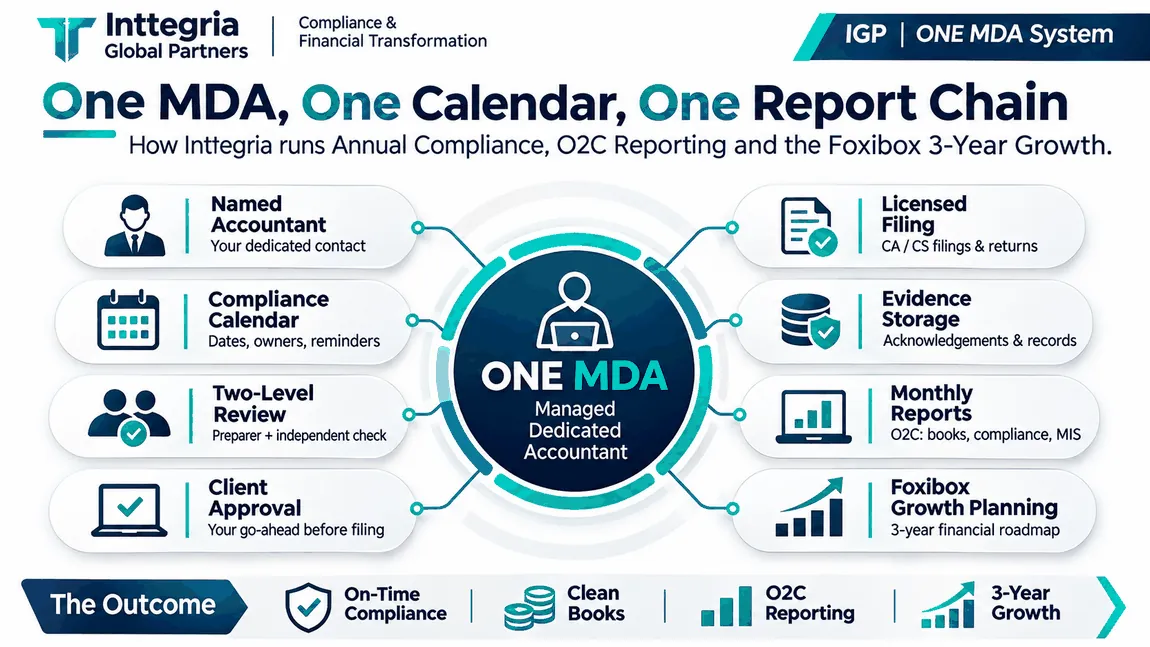
ONE MDA, Inttegria's compliance and finance support system built on the IGP framework, exists to close exactly those gaps: a named accountant, a calendar with owners, two-level review, client approval before filing, and a report trail that proves each step.
What is a managed dedicated accountant? ONE MDA explained
MDA stands for Managed Dedicated Accountant: a named accountant who knows your business, runs your books and your calendar, and has a back-up for when they are away. This is what managed dedicated accountant compliance in India looks like when it is run as a system rather than as a favour. Behind the accountant sit reviewers, a licensed partner for statutory sign-offs, and an expert desk for industry, legal and company secretarial questions. Meet the MDA service to see how it is staffed.
| Layer of support | Who | What they do |
|---|---|---|
| Named accountant (MDA) | Your dedicated contact | Books, reconciliations, GST and TDS workings, calendar upkeep |
| Back-up accountant | Named in advance | Continuity during leave or absence |
| Independent reviewer | Someone other than the preparer | Second-level check on every deliverable |
| Licensed partner | CA, CS or other licensed professional | Statutory sign-offs and filings after your approval |
| Expert desk | Law, chartered accountancy, company secretarial, regulation | Escalated industry, legal and secretarial questions |
Who does what: Inttegria provides the data layer, the checklist and the coordination. Licensed professionals sign and file statutory returns after you approve them. Nothing is filed without your approval.
How do ONE MDA and the service tiers fit together?
The service framework is built in tiers. The MDA is the main consultant at the centre, and the service deepens as you move up. Compare every tier side by side, or see plans and pricing.
| Tier | Name | What the MDA covers |
|---|---|---|
| L1 | Essential Bookkeeping | Bookkeeping and accounting, plus the standard service |
| L2 | Accounting + Compliance Filing | Adds compliance filing and advisory diagnosis |
| L3 | D-AOX | Adds finance management and finance MIS |
| L4 | FOXIBOX | Financial partner handling the entire accounts and finance department |
Compliance calendars appear from L2 upward. Essential clients still benefit from clean books that make later compliance faster. Tier scope decides which obligations are covered, and anything outside scope is marked Not covered rather than silently ignored.
The Three Clocks: how the MDA runs your compliance calendar
A due date alone is a wish. ONE MDA runs three clocks for every obligation, so the legal date is never the first time anyone looks at the work.
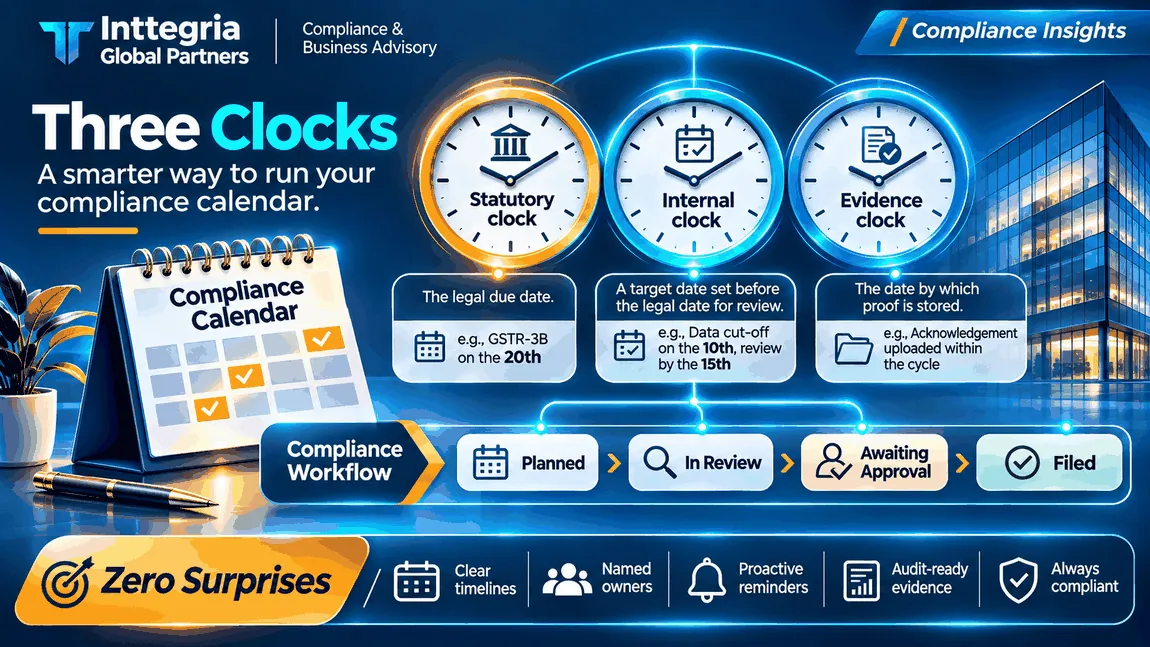
| Clock | Meaning | Example |
|---|---|---|
| 1. Statutory clock | The legal due date | GSTR-3B on the 20th |
| 2. Internal clock | A target date set before the legal date so there is time to review | Data cut-off on the 10th, review by the 15th |
| 3. Evidence clock | The date by which proof is stored | Acknowledgement uploaded to the data room within the cycle |
How an item moves through the calendar
Every calendar entry has an owner, a due date and a status: planned, scheduled, data awaited, in review, awaiting your approval, filed. Reminders reach you at least seven days before the due date. When your profile changes (new state, turnover threshold, new hires, first export, new director) the calendar updates to match.
The monthly rhythm
- Check that records are complete and send a list of pending items.
- Reconcile bank, vendor and customer balances.
- Prepare GST and TDS workings and review them.
- You approve the returns due; a licensed professional files them.
- TDS deposit is checked against the 7th, GSTR-1 against the 11th, PF and ESI against the 15th, GSTR-3B against the 20th.
- By working day 15, you receive the monthly pack: profit and loss, balance sheet, cash position and cost commentary.
The quarterly rhythm
Quarterly TDS returns (31 May, 31 July, 31 October, 31 January), advance tax instalments (15 June, 15 September, 15 December, 15 March), and a review meeting on cash, MIS and open exceptions. This quarterly meeting is where the MDA reviews tier fit and recommends changes. For the full list with owners and evidence, read the company compliance checklist.
The annual compliance service, quarter by quarter
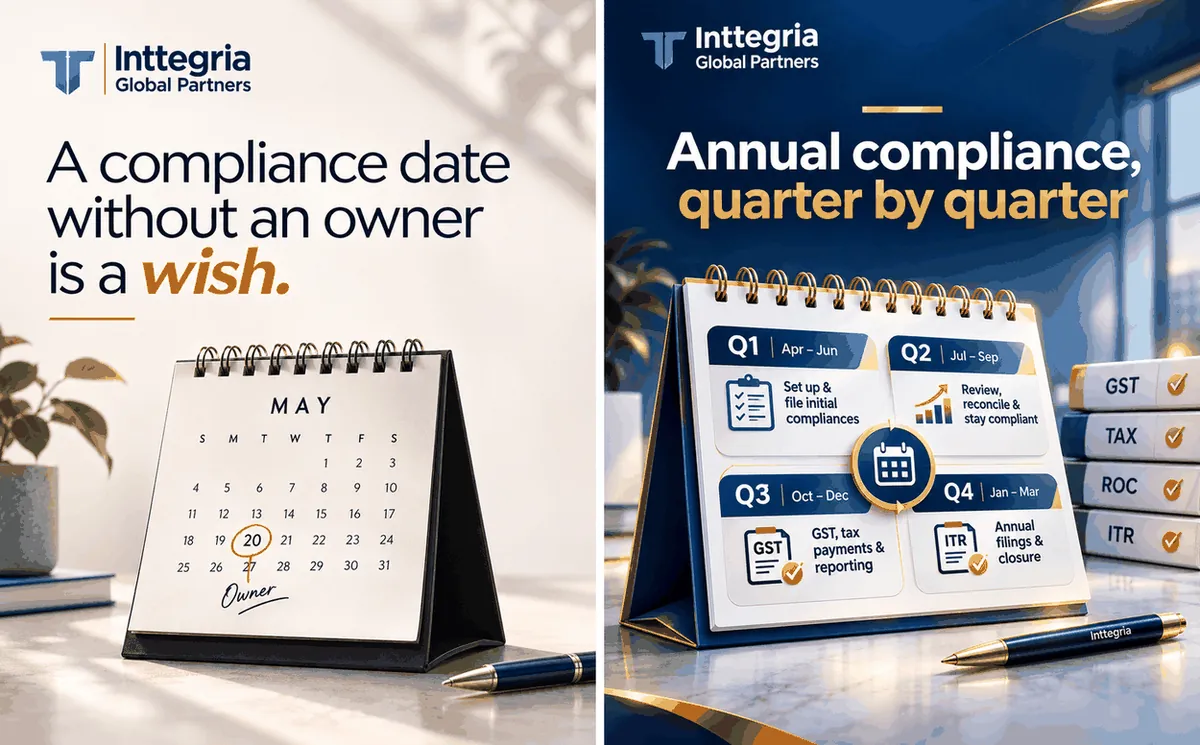
The Indian financial year runs April to March. The annual compliance service is organised so that nothing hits in the last week.
| Quarter | Compliance focus | Typical items |
|---|---|---|
| Q1 (Apr to Jun) | Close the previous year, start the new one | Quarterly TDS return (31 May); LLP Form 11 (30 May); DPT-3 where applicable (30 June); advance tax (15 June); year-end accounts finalisation |
| Q2 (Jul to Sep) | Governance and company cycle | Quarterly TDS return (31 July); AGM for most companies and DIR-3 KYC for directors (30 September); advance tax (15 September); board meetings |
| Q3 (Oct to Dec) | Returns and annual forms | LLP Form 8 (30 October); income tax return where tax audit applies (31 October); quarterly TDS (31 October); ADT-1, AOC-4 and MGT-7 within 15, 30 and 60 days of the AGM; advance tax (15 December); GSTR-9 (31 December); MSME dues reporting where applicable |
| Q4 (Jan to Mar) | Plan and prepare | Quarterly TDS (31 January); advance tax (15 March); year-end planning, ITC reconciliation, next year's calendar draft |
Annual items for companies: AGM and board meetings (at least four a year for most companies), auditor appointment, DIR-3 KYC, financial statements, annual return, DPT-3 where applicable, income tax return and the GST annual return. LLPs, partnerships, sole proprietors and NGOs follow their own lists, as set out in Blog 1.
What the annual service delivers at the end
The Annual Compliance Closure Report: every annual filing with its acknowledgement, open items carried forward, and the calendar for the next year. It is the document a bank, investor or tender authority is most likely to ask for, because it shows each filing was done, approved and closed, not merely submitted.
How does the accuracy system catch errors?
- The right starting point: The checklist is built from your profile, not a generic template. A company without GST registration never sees GST returns; a manufacturer sees factory, pollution and labour items.
- Two-level review: Every deliverable passes a preparer check and an independent reviewer check.
- Your approval before filing: You review the return summary and the figures behind it, not only the acknowledgement afterwards.
- More than one person behind every task: Named accountant, back-up, reviewer, licensed partner, expert desk.
Support without noise: you hear about a problem when it matters, through proactive alerts on deadlines, notices, mismatches or cash risk, not a flood of reminders.
The mismatches the checklist is built to catch
- Input tax credit on invoices the supplier has not reported
- GSTR-1 and GSTR-3B that do not agree
- Turnover crossing a threshold
- Auditor appointment never filed
- Director KYC missed by passive directors
- TDS under the wrong section, rate or PAN
- Annual forms filed with stale data
- MSME dues not reported where applicable
- Income tax and GST figures that disagree
O2C reports: Organization to Compliance report generation
O2C here means Organization to Compliance: a single chain that starts from who your organization is and ends in reports that prove what was done. Because every report is generated from the same data, you are not chasing information across different people. See the O2C framework for the standard behind it.
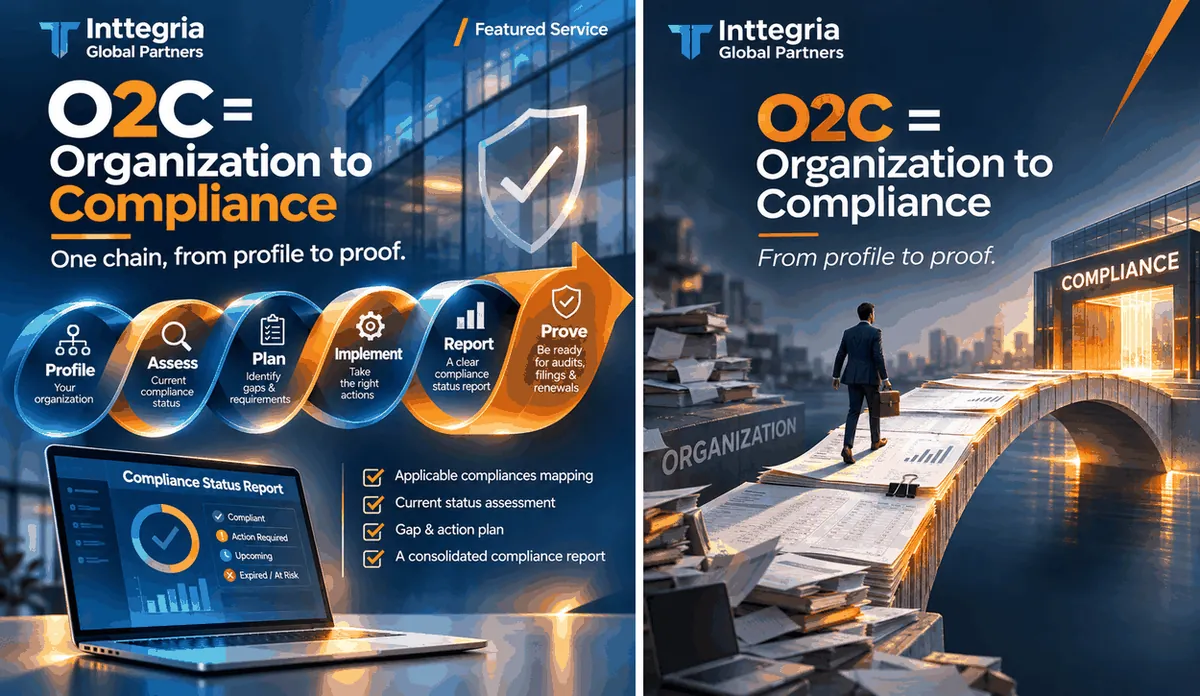
The O2C chain
| Link | What happens | Output |
|---|---|---|
| 1. Organization profile | Entity, operation, industry, turnover band, state, workforce, cross-border activity recorded | Compliance DNA record |
| 2. Obligation map | Applicable filings and licences selected from the profile | Personalised obligation list |
| 3. Calendar | Obligations scheduled with owners and three clocks | Compliance calendar |
| 4. Work | Reconciliation, workings, preparation, review | Working papers |
| 5. Approval and filing | Your approval, then licensed professional files | Acknowledgements |
| 6. Evidence | Proof stored in the data room | Data room index |
| 7. Reporting | Reports generated from the same data | O2C report set |
| 8. Insight and action | Exceptions and patterns reviewed, tier fit checked | Quarterly review decisions |
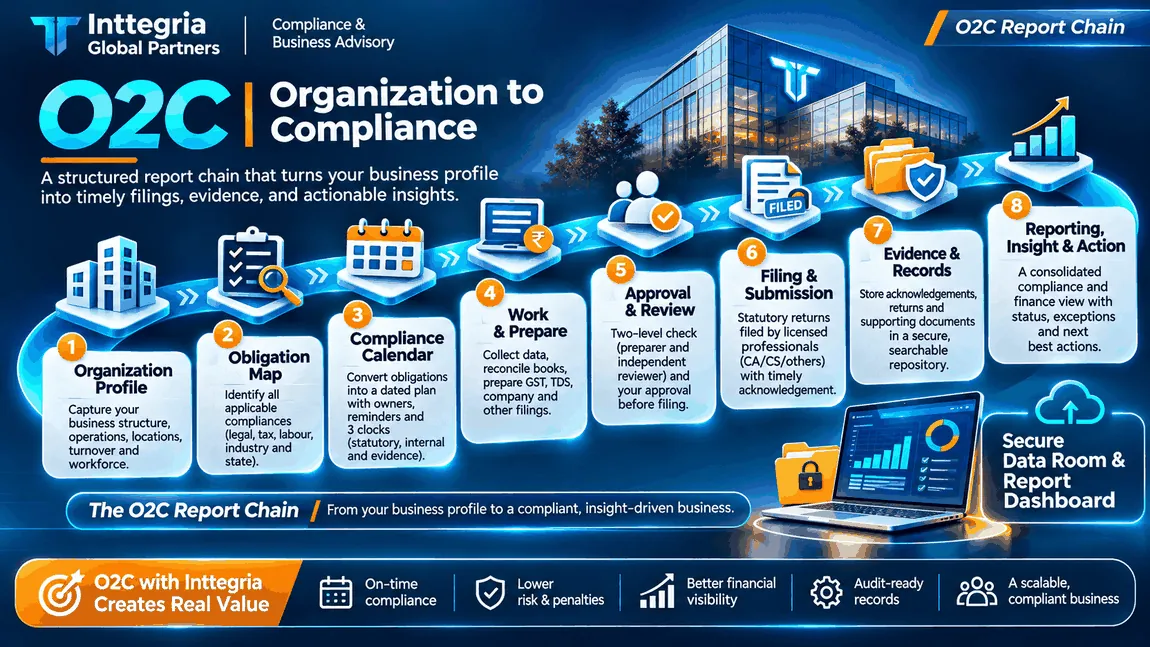
The O2C report set
| Report | When | What it shows |
|---|---|---|
| Monthly MIS pack | By working day 15 | Profit and loss, balance sheet, cash position, cost monitoring, commentary |
| Compliance status report | Monthly | Every filing as filed, awaiting approval, in review, data awaited, scheduled or planned, with owners and dates |
| Exceptions log | Monthly | Mismatches, pending items and risks, with action taken and next owner |
| Reconciliation summary | Monthly | Bank, vendor, customer, GST and TDS reconciliations, unresolved items explained |
| Quarterly review pack | Each quarter | Scorecard of on-time filings, open exceptions, cash trend, decisions taken |
| Annual compliance closure report | Year end | Every annual filing with acknowledgement, items carried forward, next year's calendar |
| Data room index | On request | Acknowledgements, working papers and approvals in one secure place |
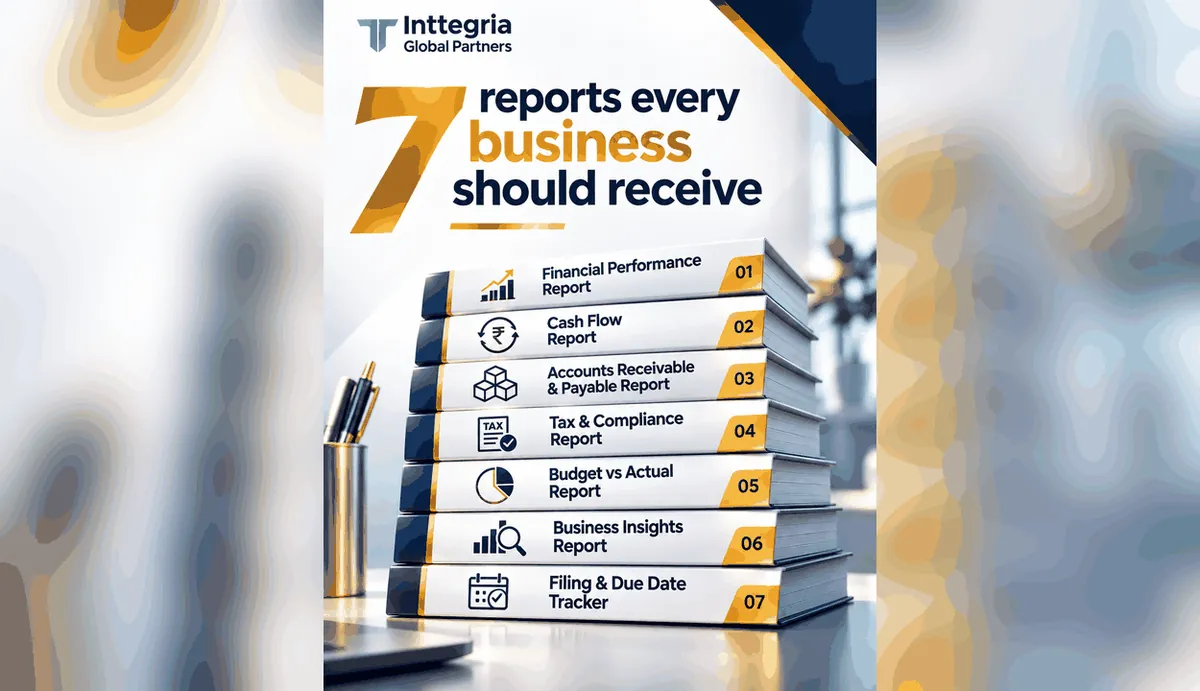
How an O2C report is generated
- Data enters once (books, bank, GST and TDS data, filing acknowledgements).
- Reconciliations run and exceptions are flagged.
- The preparer builds the report; the independent reviewer checks it.
- The MDA adds commentary and the delivery lead checks readiness.
- The report is published to your view and stored in the data room.
- Insights from the report feed the next quarterly review.
The data room holds the live financial and compliance status of your organization, which is also what lenders, investors and auditors ask for. If you want a one-time health check first, the O2C Report gives you that picture with a prioritised action list.
The Foxibox 3-year financial growth management challenge
Compliance protects a business. Growth management builds it. Foxibox, the fourth tier, makes Inttegria your financial partner by handling the entire accounts and finance department. In market terms this is an outsourced finance department, close to what many businesses look for in virtual CFO services, with a defined programme around it. The 3-Year Challenge is a structured 3-year financial growth plan for SMEs, with a baseline, targets and reviews.
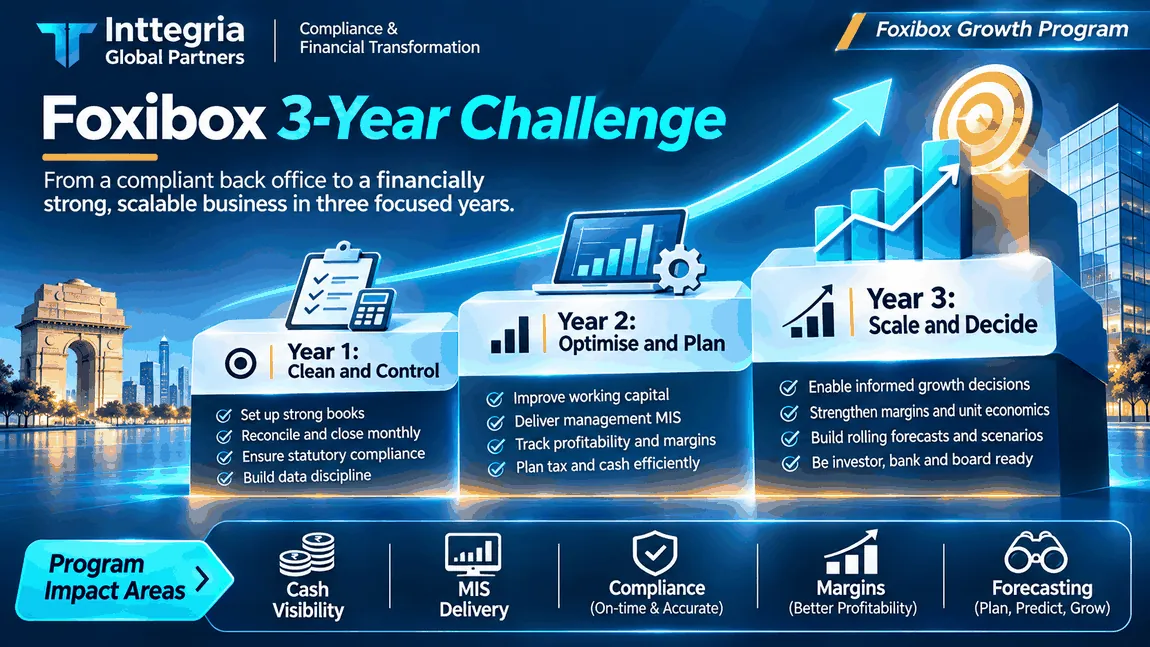
The shape of the challenge
| Year | Theme | Goal | What changes |
|---|---|---|---|
| Year 1 | Clean and Control | Zero surprises | Books complete and reconciled; compliance calendar running with owners; monthly MIS by working day 15; cash visibility; baseline KPIs set |
| Year 2 | Optimise and Plan | Better margins and cash | Cost monitoring, working capital review, budgets and forecasts, tax planning, KPI scorecard in every quarterly review |
| Year 3 | Scale and Decide | Decisions backed by data | Funding and investor readiness, board-level reporting, expansion and entity-structure decisions, exit or succession readiness |
The scorecard
| KPI | Why it matters | Year 1 target | Year 2 target | Year 3 target |
|---|---|---|---|---|
| On-time statutory filings | Avoid fees and notices | Baseline, then 100 percent | 100 percent | 100 percent |
| MIS delivery | Decisions need timely numbers | By working day 15 | By working day 10 | By working day 7 |
| Reconciliation lag | Faster close, fewer errors | Baseline | Reduce | Reduce further |
| ITC match rate | Protect working capital | Baseline | Improve | Sustain |
| Cash visibility | Avoid shortages | Monthly cash view | 13-week forecast | Rolling forecast with scenarios |
| Gross and operating margin | Profit quality | Baseline | Targeted improvement | Sustained improvement |
| Receivable and payable days | Working capital | Baseline | Improve | Optimise |
| Forecast accuracy | Planning quality | Not applicable | Baseline | Improve |
| Open exceptions older than 30 days | Control | Baseline | Reduce | Near zero |
Targets in the Baseline cells are set with you in the first 30 days; improvement targets are agreed against that baseline, not an industry average.
The review rhythm
- Monthly: MIS pack, compliance status, exceptions.
- Quarterly: scorecard review with the MDA, D-AOX sub-lead and Foxibox head; tier fit check.
- Annually: Annual Compliance Closure Report plus a challenge review of what moved, what did not and the next year's plan.
Who is in the room
The MDA is the main consultant and runs cycle control. The D-AOX sub-lead supports finance management, and the Foxibox head leads the finance partnership. At Foxibox level the service offers expert knowledge, expert representation, decision support, consulting and mentoring.
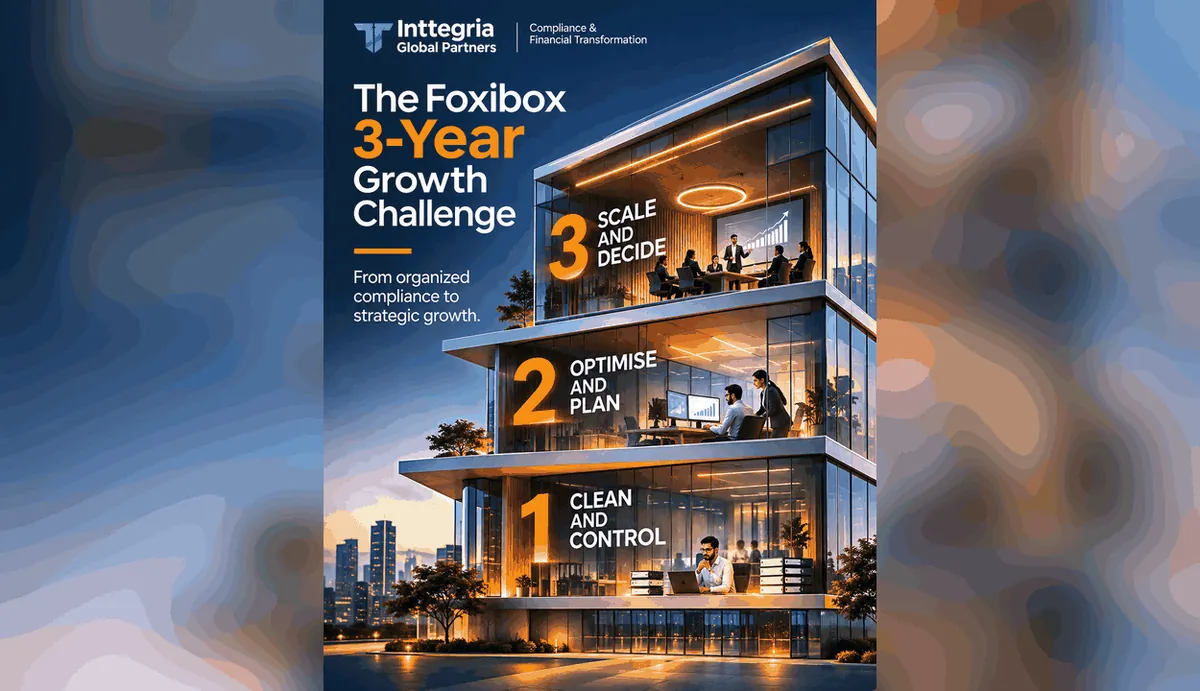
Compliance DNA: the profile behind everything
Every calendar, checklist and report starts from seven facts: entity type, operation type, industry, turnover band, state, workforce and cross-border activity. Change any one and the obligation map changes. You can review and correct the profile at any time, and the checklist re-runs for affected items. Not sure which facts apply to you? Find your service in a few questions, or see the Compliance Calendar service.
Inttegria service map
- Run compliance end to end: ONE MDA
- Books only: Essential Bookkeeping
- Books plus filing and advisory: Accounting and compliance filing
- Finance management and MIS: D-AOX
- Entire finance department: Foxibox
- Know what applies to you: Find your service
- Run your compliance calendar: Compliance Calendar service
- Annual filings for companies and LLPs: Annual Compliance + MDA
- GST registration and returns: GST services
- Income tax and ITR: Tax and ITR filing
- Company or LLP setup and MCA changes: Registration services
- Trademark and IP: IP and trademark services
- Contracts and legal support: Legal services
- Reports and evidence: O2C Report
- Growth and finance partnership: Foxibox 3-year challenge
Frequently asked questions
Is a checklist enough to run compliance?
A checklist says what must happen and when. Running it well needs a named owner, a reviewer and an approval step, which is what ONE MDA provides.
Who signs statutory filings?
Licensed professionals sign and file after your approval. Inttegria provides the data layer, checklist and coordination.
How often do I see reports?
Monthly MIS and compliance status each month, a review pack each quarter and the closure report at year end.
What if my details change mid-year?
The profile is updated and the checklist re-runs for affected items.
What does O2C stand for?
Organization to Compliance: the chain from your organization's profile to reports that prove each filing was done, approved and closed.
Is the 3-year challenge a guarantee?
No. It is a structured programme with a baseline, agreed targets and reviews. Results depend on your business and inputs.
This article is general information, not tax, legal or investment advice. Dates are recurring standards, so confirm each one on the official portal every year. Programme targets in this article are a design for discussion, not a promise of results.
Want a dedicated accountant for your business?
Meet the MDA service, or tell us what you need and we will come back with a plan.