Trademark in India, Part 1: Build and File
An agile playbook to choose, clear and register a brand name. By Inttegria. Part 1 of 2; continue with Part 2: Protect and Scale. Fees checked on 10 November 2026; always verify at ipindia.gov.in. General information, not legal advice.
The short version
A trademark is a legal right over a name, logo, tagline, sound, colour or shape in specific classes of goods or services. A brand is the meaning customers attach to it. You need both, and the cheapest moment to get the trademark right is before you print, launch or announce anything.
Most founders treat trademarking as a form to fill. The people who avoid costly rebrands treat it as a short, structured project. This guide splits that project into sprints, each with a clear goal, tasks and a "definition of done". Part 1 covers Sprints 0 to 2, from understanding the asset to filing the application. Part 2 covers Sprints 3 to 5: defending, using and scaling the brand.
| Sprint | Goal | Covered in |
|---|---|---|
| 0\. Foundation | Understand what you are protecting and why | Part 1 |
| 1\. Discover and clear | Choose a name that is both strong and legally available | Part 1 |
| 2\. Structure and file | Right applicant, right classes, right cost, application filed | Part 1 |
| 3\. Examine and defend | Handle objections, opposition and deadlines | Part 2 |
| 4\. Use and comply | Use the mark, the brand and the bank account correctly | Part 2 |
| 5\. Scale and renew | Multiple brands, international, transfers, renewals | Part 2 |
Sprint 0: Foundation
What the law gives you
India's trademark system runs under the Trade Marks Act, 1999 and the Trade Marks Rules, 2017, administered by the Trade Marks Registry (IP India). Registration gives you:
- Exclusive right to use the mark for the registered goods or services across India.
- The right to sue for infringement, not only for passing off, with a presumption that the registration is valid.
- The ® symbol and a real deterrent against copycats.
- An asset you can sell, license, franchise, pledge and show to investors.
- Marketplace leverage: Amazon, Flipkart and similar platforms give brand registry and takedown tools to filed or registered marks.
- A shield against later filers: the Registry can refuse confusingly similar later applications.
Registration is strong but not absolute. India protects prior users: someone who used a similar mark earlier can still oppose, seek cancellation or sue you.
Trademark is not company name, domain or GST trade name
| Item | What it gives | What it does not give |
|---|---|---|
| Company name (MCA) | Legal identity unique among company names | Any brand right against others |
| Domain name | A web address | Ownership of the name |
| GST / Udyam trade name | Tax and business identity | Exclusivity |
| Trademark | Exclusive brand right in registered classes | Rights in unrelated goods or other countries |
MCA can refuse, or later direct a change of, a company name that conflicts with a registered trademark. The belief that "I have a company, so the brand is mine" is false.
Types of trademarks
| Type | Protects | Practical note |
|---|---|---|
| Word mark | The name in any style | Your core asset; file first |
| Device / logo mark | The specific design | Protects only that look; separate application |
| Composite mark | Name plus logo together | May need a disclaimer on common words inside |
| Tagline | A catchphrase | Must be distinctive, not plain praise |
| Series mark | A family of near-identical marks | One application instead of many |
| Collective mark | Mark used by members of an association | Co-operatives, trade bodies |
| Certification mark | A guarantee of origin or quality | Owner must not trade in those goods |
| Shape / 3D mark | Product or pack shape | Hard if shape is functional or customary |
| Colour mark | A colour combination | A single colour usually needs years of proof |
| Sound mark | A jingle or audio signature | Accepted in principle; confirm current practice |
| Well-known mark | A mark known to the relevant public | Protected even for unrelated goods |
| Unregistered mark | Reputation from use | Protected only via passing off, with proof |
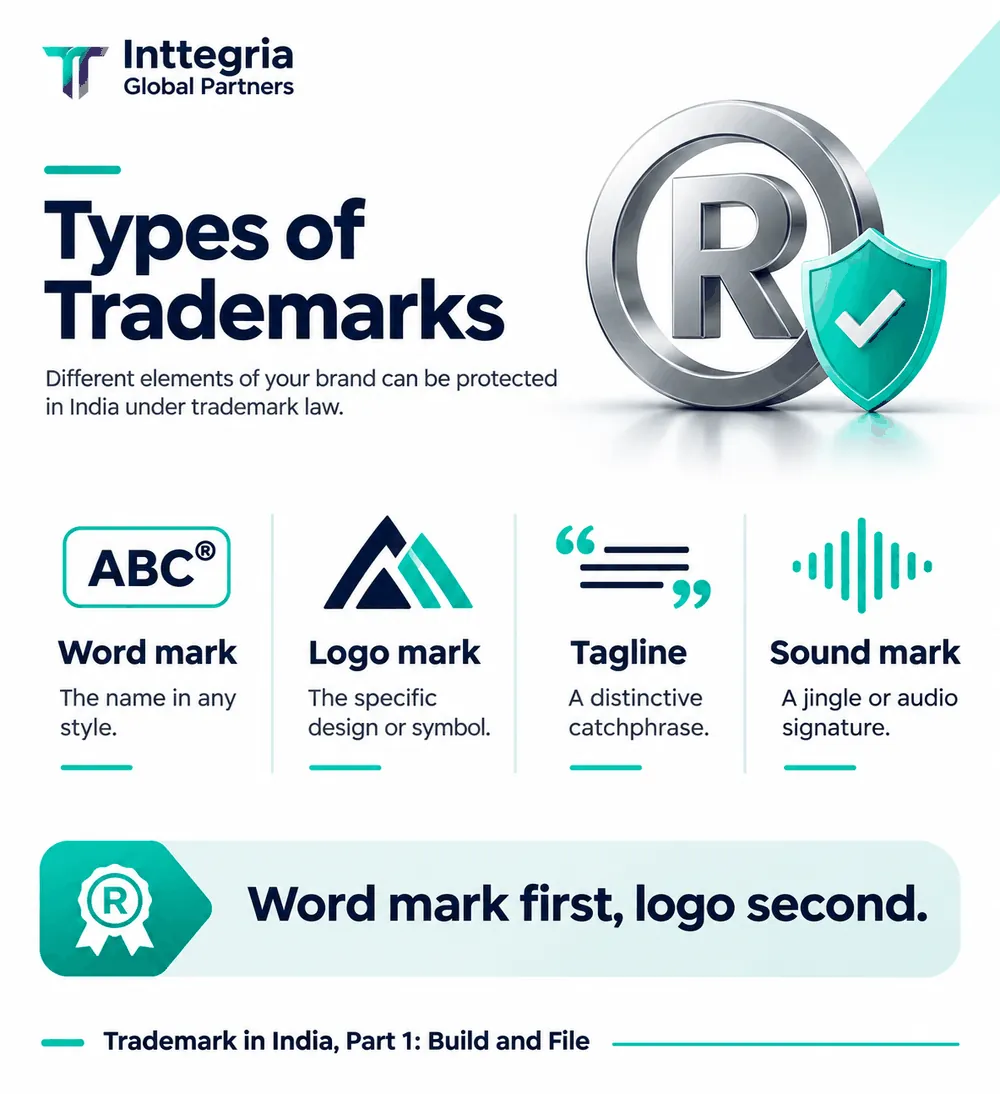
Definition of done, Sprint 0: you can explain the difference between trademark, company name, domain and brand, and you know which types of mark you will file (usually word mark first, logo second).
Sprint 1: Discover and clear
This is the sprint most founders skip and most regret. A week of research here can save a year later.
Step 1: Define the brief
- Objective: what must the brand achieve (premium, mass market, trust, speed)?
- Market and geography: local, state, national, export.
- Customer: who they are, what language they speak, what triggers a purchase.
- Product or service: what you sell now and in five years.
- Competitors: list the top ten names and note the sounds and styles they share. A name that blends in earns objections and no recall.
Step 2: Name strategy, metaphor and science
- Metaphor: a name that evokes an idea (strength, warmth, speed) is stronger and easier to register than one that literally describes the product.
- Sound: short names of two to three syllables are easier to remember. Sharp consonants (K, T, P) tend to suggest speed and precision, soft sounds (M, L, S) comfort and care. Test it aloud in Tamil, Hindi and English.
- Spelling: if people need help spelling it on a phone call, it will leak customers.
- Meaning abroad: check the name in every language of your target markets.
- Sensitivity: avoid sacred, political or offensive terms; they risk refusal under Section 9.
Step 3: Know how the law judges similarity
Indian courts and the Registry ask whether an average consumer with imperfect recollection would think two marks come from the same source.
- Visual, phonetic, structural and conceptual similarity are all tested. In Amritdhara v. Satya Deo Gupta, the Supreme Court treated similar-sounding names as confusing on overall impression.
- The dominant part often decides the case. Adding generic words such as "Foods", "Tech" or "Pvt" rarely saves you.
- Translations and transliterations can count as the same mark, so a Tamil or Hindi version of an existing mark is a risk.
- Pharma and health are judged strictly (Cadila v. Cadila) because confusion can cause harm.
- Similarity crosses class numbers. Classes are a filing tool; courts look at whether goods are related in trade.
Distinctiveness spectrum, strongest to weakest: invented (Kodak), arbitrary (Apple for computers), suggestive, descriptive (often refused), generic (never registrable). Surnames, places and common first names are weak.
Step 4: Run a real clearance search
- IP India public search: exact, phonetic and similar-start searches in your class and related classes.
- Search Hindi, Tamil and other-script versions plus common misspellings.
- Search the market for unregistered users: Google, Instagram, Facebook, LinkedIn, YouTube, app stores, Amazon, Flipkart, Justdial, IndiaMART.
- Check MCA company and LLP names.
- Check domain and social handles.
- If exporting, check WIPO Global Brand Database and national registers.
- Repeat the registry search just before filing: recently filed applications can lag in public search.
Step 5: Score the shortlist
Rate five to seven names from 1 to 5 on distinctiveness, ease of pronunciation, availability in register and market, meaning, ability to stretch into new products, and domain and handle fit. Pick the highest-scoring legally available name, not simply your favourite.
Definition of done, Sprint 1: one primary name and one backup name, each with a written search record.
Sprint 2: Structure and file
Who should own the mark
The applicant must be the owner or intended user. The choice affects fee, ownership and future transfer cost.
| Individual / sole proprietor | Company / LLP / firm | |
|---|---|---|
| Government fee per class (e-filing) | ₹4,500 | ₹9,000 (₹4,500 if DPIIT startup or micro/small enterprise) |
| Strength | Fast, simple, no MCA | Clean ownership for investors, banks, acquirers |
| Risk | Brand belongs to the person, so the company later needs a licence or an assignment with stamp duty and possibly GST | Needs exact legal name, CIN, address and authorised signatory |
The fee trap: the ₹4,500 slab is for individuals, startups and micro and small enterprises. Medium enterprises and ordinary companies pay ₹9,000. Claiming the concession needs valid proof.
Rule of thumb: if the brand will carry the business, file in the name of the entity that will own the business. If you plan to incorporate within a year, either file in the company's name after incorporation, or accept that you will pay for an assignment later.
There is no limit on how many marks an individual or a company can register. Each application is per mark, per class, and brand name and logo count separately.
Company and MCA changes
A trademark filing itself needs no MCA filing, but trading under the brand may require:
- Objects clause: if the brand's business is outside the MOA, alter the objects by special resolution and file MGT-14 with the altered MOA. Check the current form requirement on MCA21.
- Name change: if the brand becomes the company name, apply for a name change and obtain a fresh certificate of incorporation.
- GST, Udyam, FSSAI, Shops and Establishment: update trade names and activities.
- Section 12, Companies Act: the registered name must appear on invoices, letterheads and the signboard. The brand sits beside it as "a brand of ABC Private Limited".
The brand name itself does not need to be in the MOA. The business activity does.
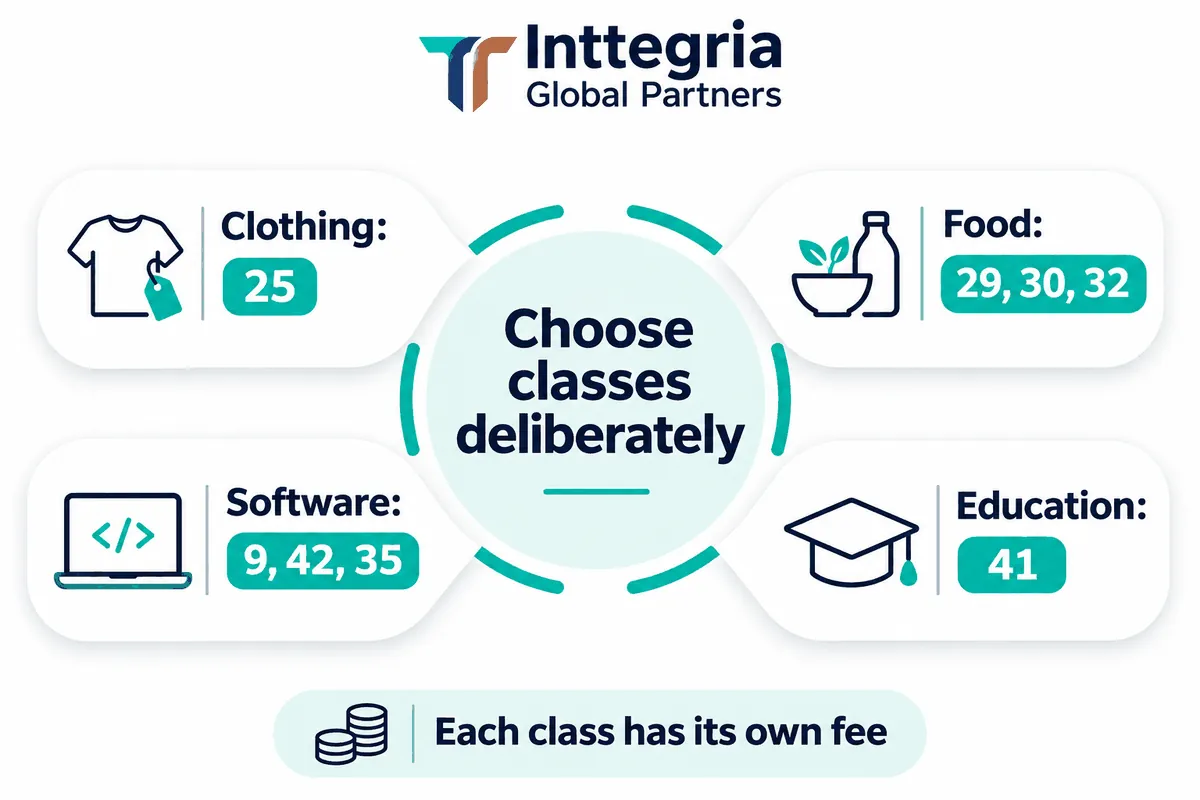
Choose classes deliberately
India uses the 45-class Nice system: Classes 1 to 34 are goods, 35 to 45 are services. Each class has its own fee.
| Business | Classes to consider |
|---|---|
| Clothing and fashion | 25, 24, 18, plus 35 for retail |
| Food and snacks | 29, 30, 32 |
| Restaurant or cafe | 43 (and 30 for packaged goods) |
| Software, app, SaaS | 9, 42, 35 |
| Education | 41 (and 9 or 16 for content) |
| Cosmetics | 3 |
| Pharma, nutraceuticals | 5 |
| Jewellery | 14 |
| E-commerce | 35 plus product classes |
- The specification is binding. You can narrow it later but cannot add new goods to an existing application. File for today plus the next three to five years.
- Do not default to Class 35. It covers services to others, not manufacturing.
- Cover neighbours with one or two defensive classes if budget allows.
- Do not over-file. Unused classes cost money and are vulnerable to non-use removal after five years.
- Word mark first, logo second.
What it costs
Government fees (e-filing, per class, per mark)
| Activity | Individual / startup / small | Company / others |
|---|---|---|
| Application (TM-A) | ₹4,500 | ₹9,000 |
| Paper filing | ₹5,000 | ₹10,000 |
| Expedited examination | ₹20,000 | ₹40,000 |
Renewal, opposition, assignment and restoration fees are covered in Part 2.
Professional fees (market ranges, not government charges)
| Service | Typical range |
|---|---|
| Search report | Free to ₹2,000 |
| Filing | ₹1,500 to ₹10,000 |
| Reply to examination report | ₹3,000 to ₹10,000 |
| Each hearing | ₹3,000 to ₹5,000 |
GST at 18% applies to professional fees. A low-priced "package" normally excludes the government fee, examination reply, hearings and GST. Always ask for a written, all-in cost sheet.
Example: a company filing one mark in two classes pays ₹18,000 government fee, plus roughly ₹12,000 to ₹25,000 in professional fees if there is one objection and one hearing, plus GST.
The filing process at a glance
| Step | What happens | Typical time |
|---|---|---|
| 1\. Filing (TM-A) | Online, with digital signature, authority, user date, logo and proof of concession | 1 day |
| 2\. Formalities check | Application number and status | Days to weeks |
| 3\. Examination | Accepted or objected | About 1 to 3 months in recent practice |
| 4\. Reply and hearing | Reply within 30 days | 1 to 6 months |
| 5\. Advertisement | Published in the Trade Marks Journal | Weeks |
| 6\. Opposition window | Any third party may oppose within 4 months | 4 months |
| 7\. Registration | Certificate issued | Weeks |
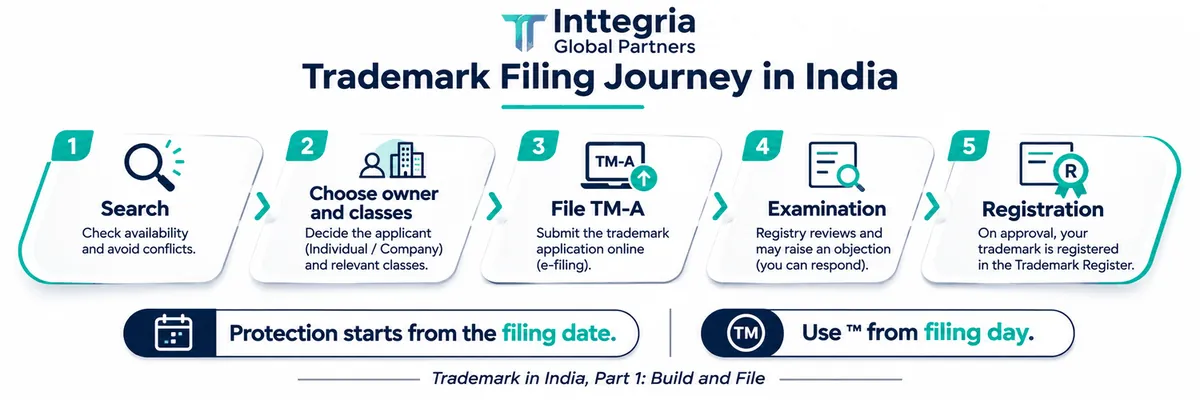
Timelines run from about 9 to 12 months for a clean file, 12 to 18 months with an objection, and 2 to 5 years with opposition. Be wary of anyone promising a fixed "30-day registration". Protection starts from the filing date, and you can use ™ from that day.
Filing hygiene that providers rarely mention
- Put your own email and mobile on the application and keep every acknowledgement and application number. You, not your agent, are the owner.
- Claim a "used since" date only if you can prove it. Otherwise file as "proposed to be used".
- File before you announce. Squatters watch MCA name approvals, domain registrations and social launches.
- MCA name approval, GST trade name and domain registration are not trademark clearance.
Definition of done, Sprint 2: application filed in the right name, classes and specification, with acknowledgement saved and deadlines calendared.
Where Inttegria adds value
Most providers sell a filing. Inttegria's approach is to integrate the whole chain so that brand, law and company paperwork agree with each other:
- Brand R&D sprint: structured naming brief, similarity and phonetic risk scoring, and a documented clearance record before you spend on branding.
- Applicant and structure advice: individual, company or IP-holding entity, and the concession eligibility check, so you do not pay an assignment bill later.
- Class and specification design: classes mapped to your real business and a three-to-five-year plan, not a default package.
- Aligned compliance: MOA objects, GST, Udyam and licence updates checked against the brand.
- Transparent, all-in costing: government fee, professional fee, GST and foreseeable objection costs in one sheet.
- Owner-controlled filing: your contact details and your documents, with every acknowledgement shared with you.
Part 1 checklist
- [ ] Brief written: objective, market, customer, product, competitors
- [ ] Five to seven names scored; backup ready
- [ ] Registry, market, MCA, domain and handle searches recorded
- [ ] Applicant decided and proof of concession gathered
- [ ] Word mark first, logo second
- [ ] Classes and specification chosen
- [ ] Written all-in cost sheet received
- [ ] Filed before any public announcement
- [ ] Your own email and mobile on the application
Next: read Part 2: Protect and Scale to learn how to handle objections and opposition, use ™ and ® correctly, run multiple brands, go international and keep the mark alive.
Want a dedicated accountant for your business?
Meet the MDA service, or tell us what you need and we will come back with a plan.