Section 8 Companies and NGOs: The Problems Founders Face, Stage by Stage, and How to Avoid Them
Most founders of non-profits begin with a cause, not a legal plan. Between the cause and the paperwork sit the choice of entity, the objects clause, provisional and regular registration, 80G, Darpan, CSR, FCRA and a long list of annual filings. This guide lists the problems NGOs and Section 8 companies actually run into at each stage, why they happen and how to prevent them.
The problems come from tribunal orders, regulator rules and practitioner experience. Where the law is unclear, we say so, and you should confirm the point on the official portal or with a practising professional. The year runs April to March, and the One Calendar approach in Part 2 shows how to keep every date in view.
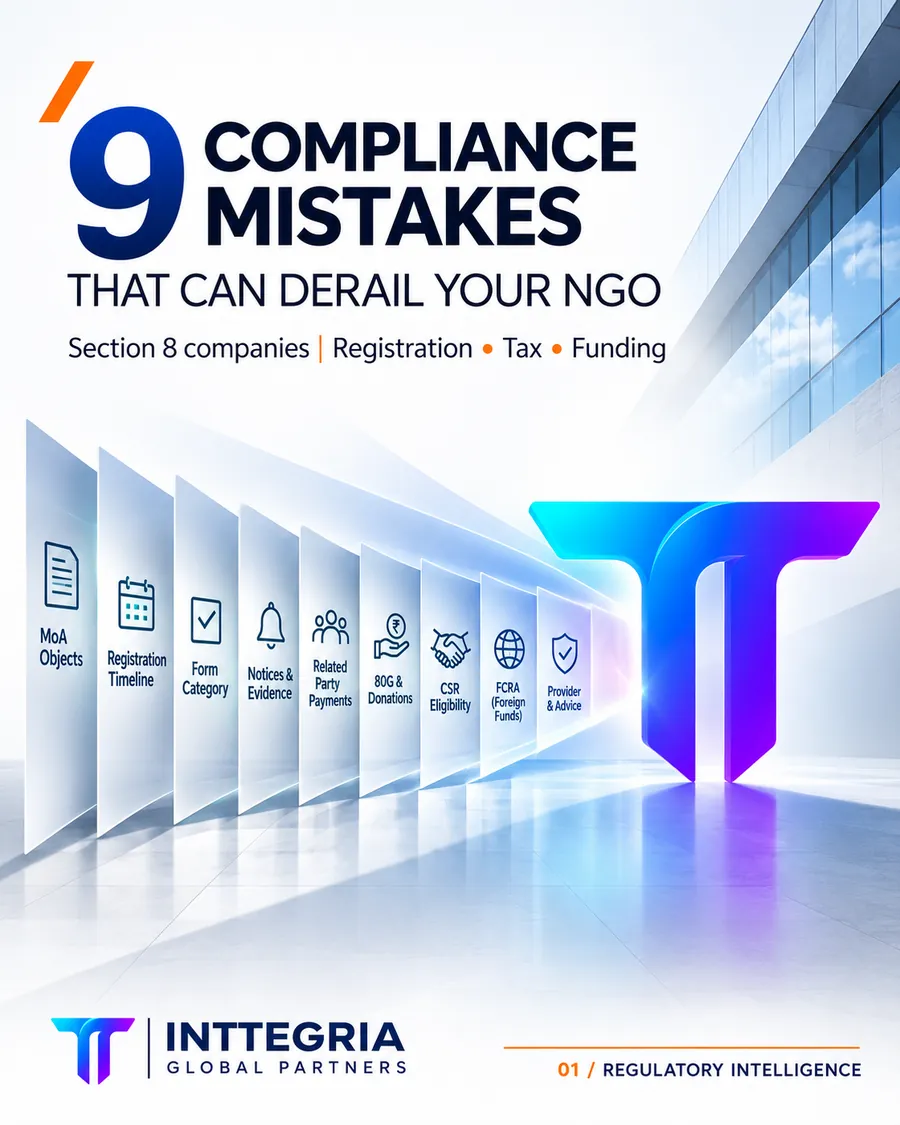
Nine compliance mistakes that can derail an NGO: MoA objects, registration timeline, form category, notices and evidence, related-party payments, 80G and donations, CSR eligibility, FCRA and provider advice.
Problems NGOs and Section 8 companies face, stage by stage
Pre-incorporation and the MoA
Problem
Why it happens
Prevention
Generic or copied MoA with business-style, vague or mixed objects
Templates reused; founders list every idea they have
Draft 8 to 12 focused charitable objects; remove anything commercial or personal-benefit
Missing non-discrimination, application-of-income or dissolution clause
Template gaps
Use the MoA checklist in the uploaded document
Objects that read as charity but contain private-benefit limbs (for example business support to individuals)
Over-broad drafting
Have an advocate review every object before filing
Conflicting advice on the licence route (INC-12 first vs SPICe+)
Provider sites are not kept current
Confirm on the MCA portal; ask the provider to cite the current form
Name rejection and objects queries from the Regional Director
Similar names, Rule 8 issues, vague objects
Run name and trademark checks first; keep the objects clause precise
DSC and DIN errors, mismatched ID proofs, owner NOC missing
Document quality
Pre-check every document against the form fields
Incorporation and the first 90 days
Problem
Why it happens
Prevention
Bank account not activated after AGILE-PRO-S
In-person KYC still needed with the bank
Plan a directors' visit; keep company documents ready
Confusion over first auditor and ADT-1
Law and form practice diverge
File ADT-1 within 15 days regardless
No three-year income and expenditure projection ready
Treated as paperwork
Prepare with the MoA
Treating 12A/80G as "later"
Founders focus on programmes
Apply for provisional registration early; align activity start with the registration clock
Statutory registers and policies never created
No one owns compliance
Appoint a compliance owner at the first board meeting
Provisional certification (Form 104 / 10A)
Problem
Why it happens
Prevention
Believing provisional equals full registration
Order looks final
Record the validity and the "whichever is earlier" rule on day one
Missing that provisional ends six months after activities start
Rule is in the order, not in marketing pages
Diarise the Form 105 deadline the day activities begin
Mixing old and new forms during the 2025-26 transition
Act replaced on 1 April 2026; sources still use 10A/10AB
Use both vocabularies, confirm form names on the portal
Donors told "80G" while only provisional approval exists
Fundraising ahead of paperwork
State the exact approval status on receipts and appeals
Building a "track record" for CSR while no activities have started
Research and planning phase counts for little
Plan pilots early; keep evidence from day one
Regular registration (Form 105 / 10AB)
Problem
Why it happens
Prevention
Application filed late, then rejected
Timelines misunderstood; no one tracks expiry
Diarise at registration; apply well before the window closes; file a condonation request with the application if late
Wrong clause or category selected in the form (for example choosing renewal instead of regularisation of provisional registration)
Dropdown choice, rushed filing
Check the category against Section 332(3) before submitting; second-person review
No response to the Commissioner's notices
Notices go to an old email or a consultant; deadlines missed
Use a monitored organisational email; log every notice and due date
Rejection for "commercial activity" through project agreements
Fee-based or contract income looks like business
Keep business incidental and in separate books; explain each contract's link to the objects
Allegation of siphoning through director honorarium, salary, rent or equipment
Related-party payments without market-rate evidence
Board-approved, documented, reasonable payments only
Doubt on genuineness of activities
No photographs, beneficiary lists, bills or bank trail
Build the evidence file from the first activity
80G rejected as a consequence of 12AB rejection
The two are linked
File both properly; fix the root cause first
Rejection, then a fresh application, then loss of effective date
Process gaps
Appeal or reapply with advice; tribunals have held that a rejection does not bar a fresh application and have remanded technical rejections
Tax on accreted income if delay is not condoned
Section 332(6) with Section 352
Treat deadlines as hard
NGO Darpan
Problem
Why it happens
Prevention
PAN name does not match the registration certificate
Different spellings across documents
Align names before applying
Portal needs details of at least three key persons with PAN and Aadhaar; typos are rejected
Real-time PAN verification
Prepare verified details first
"Duplicate PAN" because someone else registered the NGO
A third party or former member created the account
Register through your own email and mobile; keep credentials with the organisation
Assuming Darpan is mandatory for CSR
Confusion with CSR-1
Darpan helps credibility and government grants; CSR eligibility rests on CSR-1
Profile left outdated
No owner
Update at least yearly
80G and the donor side
Problem
Why it happens
Prevention
Donor's deduction lost because 80G approval had lapsed
80G has its own validity, separate from 12A
Track both expiries; renew both
Donation statement (Form 10BD / 113) and donor certificate (10BE / 114) do not match the ledger
Late or manual reporting
Reconcile the donor ledger monthly; file by 31 May
Cash donations above ₹2,000 not eligible for donor deduction (old Act rule)
Informal collection
Accept by bank or UPI; check the 2025-Act equivalent (confirm)
Donors expect a deduction, but many individuals under the new tax regime cannot claim donation deductions
Tax-regime change
Do not make tax benefit the main appeal
Donations issued receipts before approval
Fundraising ahead of approval
State approval status on every receipt
CSR
Problem
Why it happens
Prevention
CSR-1 filed before 80G is in place and rejected
Wrong sequence
Order: 12A and 80G, then CSR-1
Three-year track record cannot be shown
New entities have no history
Run documented pilots; keep activity reports and audited accounts
Name or PAN mismatch, wrong section selected, trustee details wrong
Data entry
Cross-check every field; use professional certification (required: CA, CS or CMA)
CSR-1 holds but 80G lapses
Separate expiry
Companies verify live 80G; NGO tracks it
Company due-diligence burden slows release of funds
Funders must verify registration, 80G, track record
New complexity from 2026 rules on zero-coupon zero-principal instruments via the Social Stock Exchange
Rule 4A, May 2026 amendment
Ask funders whether they use this route (confirm)
Treating Darpan or 12A alone as CSR-ready
Confusion between registrations
CSR needs CSR-1 plus the conditions above
FCRA
Problem
Why it happens
Prevention
Registration now tied to specified purposes and states
2026 Rules (22 June 2026)
Choose purposes and states carefully; changes need a formal process
Foreign national as a key functionary
New definition and restrictions
Review the board and office-bearers first
Foreign money received through the wrong account
Informal channels
Use the designated SBI New Delhi account only
Sub-granting foreign funds to another organisation
Prohibited since 2020
Do not pass on foreign contributions
Heavier FC-4 (website, social media, project-wise spend, administrative costs)
2026 Rules
Keep activity-wise and location-wise records from day one
Uncertainty from the FCRA Amendment Bill 2026
Bill pending at last check
Watch the status (confirm)
Typically about three years of operations needed before registration
Practitioner-reported
Plan on no foreign funding in the first years (confirm)
Annual company-law compliance
Problem
Why it happens
Prevention
Wrong AGM date or late AOC-4 and MGT-7
Deadlines run from the AGM date
Set the AGM date early; compute filing dates from it
Believing MGT-7A applies
Treated like a small company
Section 8 companies use the full MGT-7
DIR-3 KYC missed and DIN deactivated
Annual task forgotten
Calendar 30 September
Losing the Board-meeting relaxation
The relaxation is compliance-based; defaults in filing remove it
File on time; hold at least one meeting every six calendar months
First AGM and auditor confusion
Different rules for first auditor and first AGM
Use the document's first-90-days checklist
DPT-3 and MSME-1 forgotten
Rare filings
Ask the CS whether either applies
Large late fees
Per-day additional fees
MCA has run a 2026 compliance facilitation (amnesty) scheme; check current terms (confirm)
Annual income-tax compliance
Problem
Why it happens
Prevention
Less than 85% of income applied or validly accumulated
Planning failure
Budget so programme spend clears 85%; file the accumulation form on time
Business receipts not in separate books
Fee income mixed with grants
Separate books; test the 20% limit only if the objects are general public utility
Payments to directors and relatives at above market rates
Informal arrangements
Board approval, agreement and market-rate evidence
Audit report, return and donation statement dates confused
Dates moved by extension and by the new Act
Keep a single calendar; note that extensions are announced late (28 September for a 30 September deadline)
Form 112 transition and the return form for the new Act not yet notified (per the uploaded document)
Act changed from 1 April 2026
Confirm the form for each tax year with the CA
Treating an extension as certain
Extensions are not guaranteed
Plan to file by the original date
Other registrations (GST, EPFO, ESIC, Professional Tax)
Problem
Why it happens
Prevention
Assuming donations and sponsorship are treated alike for GST
Different facts
Get a written GST note per income stream
Not registering for Professional Tax in Karnataka
AGILE-PRO-S issues it for Karnataka companies
Confirm and file returns as required
Threshold confusion for EPFO and ESIC
Labour-code changes (confirm)
Check with the CA each year
Closure
Problem
Why it happens
Prevention
Dormant company struck off by the ROC for two years of inactivity
Section 248(1)(c)
File returns, or apply for dormant status
Unclear route for voluntary closure of a Section 8 company
Statute is not simple
Take a CS opinion before choosing a route
Tax on accreted income when exiting or on cancellation
Section 352
Dissolution clause to a similar registered entity; plan assets early
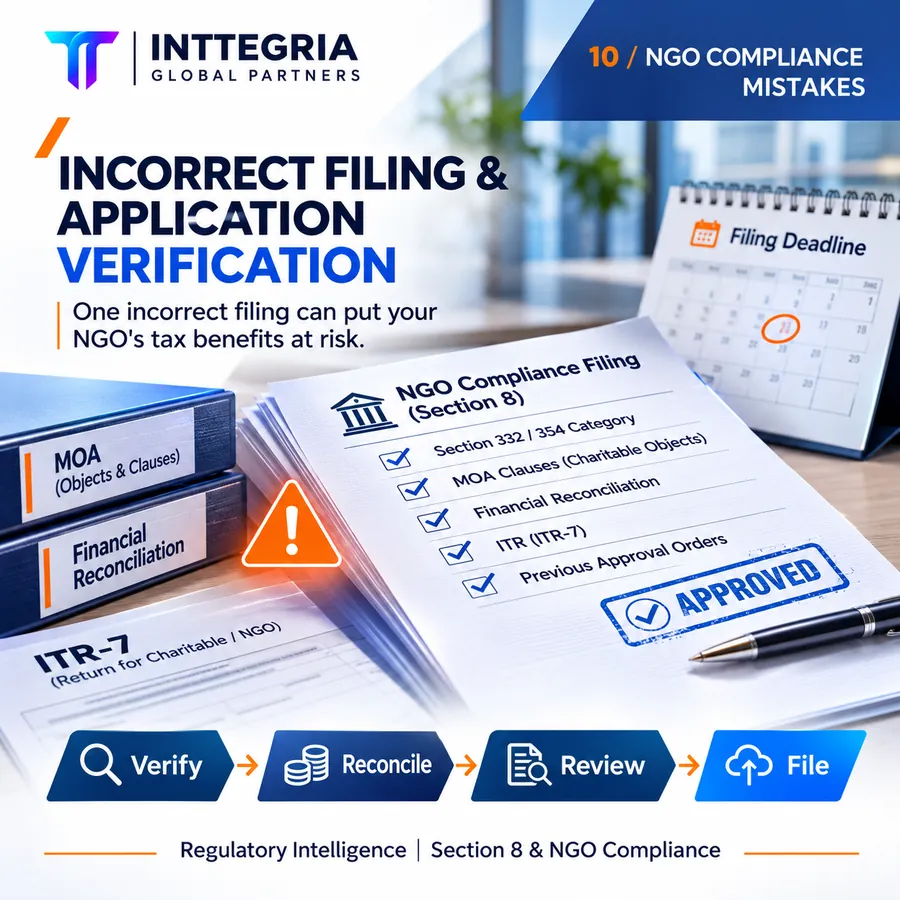
Verify, reconcile, review, then file: one incorrect filing can put an NGO's tax benefits at risk.
Problems with third-party service providers
This part has two views: what customers experience, and what providers themselves say makes the work hard. Evidence is mostly tribunal records and the providers' own public pages.
Problems customers face with providers (CAs, CSs, online consultancies, portals)
Problem
Example / evidence
What to ask or do
Stale or conflicting guidance
Provider pages still show Form 10A and old section numbers in 2026, and still describe INC-12 as a separate first step, while others say licence comes with SPICe+
Ask the provider to cite the current form and rule, with a date
Wrong form, clause or category selected
Mumbai ITAT (September 2026): the trust picked the renewal sub-clause instead of regularisation of provisional registration; the application was rejected
Insist on a pre-submission review by a second person
Missed deadlines with no tracking
Several ITAT orders on Form 10AB filed after the window; some bench orders condone, some do not
Get a written compliance calendar with named owners
No response to department notices
Applications rejected because notices were not answered
Notices should reach the organisation's own email, not only the provider's
No representation at hearings
Appeals follow rejections that were never contested
Confirm in writing whether hearing representation is in scope
"Consultant failure" is a weak defence
Pune ITAT refused to condone a 661-day appeal delay where the trust blamed an unnamed tax consultant; the Bombay High Court, in another case, quashed an ITAT order that had refused condonation after a CA's wrong-section claim. Outcomes vary
Do not rely on blaming the adviser; keep your own copy of every filing
Wrong or late appeal route
A consultant filed an appeal with the wrong authority; the tribunal condoned a 133-day delay in that case but it cost time
Confirm the appellate forum before the limitation period runs out
Flat-fee packages with unclear scope
Providers advertise flat prices (for example a stated all-inclusive annual NGO compliance fee up to a turnover cap, or registration "from ₹5,000 each")
Ask what is excluded: notices, hearings, FCRA, GST, amendments, resubmissions
Account control and credentials
Darpan error "Duplicate PAN" shows an NGO's PAN being used by someone else to register
Register accounts with the organisation's own email and mobile; keep admin access
Templates presented as tailored advice
Same MoA reused across clients (see B1)
Ask for a written explanation of each object and its tax angle
Hand-over problems when switching provider
Tribunal affidavits describe consulting a "new consultant" only after the deadline passed
Keep a documents register and shared access
Assurances of approval
Provider websites promise smooth approval; approval is discretionary and depends on genuineness
Treat any guarantee as a warning sign
How a good provider relationship should look
A written scope listing what is in and out (hearings, notices, FCRA, GST, amendments).
A compliance calendar with owners and dates, shared with the organisation.
Every filing acknowledged to the organisation, with PDFs of what was submitted.
Notices routed to the organisation as well as the provider.
Second-person review before any government form is submitted.
Written opinions, with the date and the law relied on, where the law is unclear.
Frequently asked questions
Is provisional registration the same as full registration?
No. Provisional registration is time-limited and can end earlier than people expect once activities start. Diarise the regular registration deadline the day you receive the provisional order.
Can a new NGO get CSR funding in the first year?
Usually not. CSR-1 needs valid 12A and 80G and, for most independent organisations, a three-year track record, so run documented pilots from day one.
What should I ask a provider before hiring one?
Ask for a written scope (hearings, notices, FCRA, GST), a compliance calendar with owners, copies of every filing, notices routed to your own email and a second-person review before submission.
This article is general information, not legal or tax advice. Rules, forms and due dates change, and the Income-tax Act, 2025 replaced the 1961 Act from 1 April 2026. Confirm each item on the official portal or with a qualified professional before acting.
Setting up an NGO or Section 8 company?
Talk to Inttegria about registration, tax recognition and a compliance calendar for your first year.