Founder's Finance & Integrated Business Readiness Framework
INTTEGRIA Start-Up X · Powered by FOXIBOX · Delivered through ONE-MDA (Managed Dedicated Accountant)
Why founders need a system
Start-ups rarely fail for lack of courage. Demand is untested, cash runs out unseen, the team is not aligned, or one late payment or one missed filing hits a business with no buffer. These problems leave a trail in the numbers long before they become fatal.
The official numbers show how real this is. In a written reply to the Lok Sabha in March 2026, the Ministry of Commerce and Industry reported that 6,789 of the 2,12,283 DPIIT-recognised start-ups (about 3.2%) were categorised as closed, meaning dissolved or struck off in Ministry of Corporate Affairs data, as on 31 January 2026. IT services recorded the most closures (875). These figures count formal closures only; they do not include businesses that are alive but stalled.
Founder post-mortems collected by CB Insights point to the same causes, usually in combination: no market need (42%), running out of cash (29%), the wrong team (23%), being outcompeted (19%) and pricing or cost problems (18%). Demand, cash and team are the repeating causes, and this framework is built to catch them early.
The service in one page
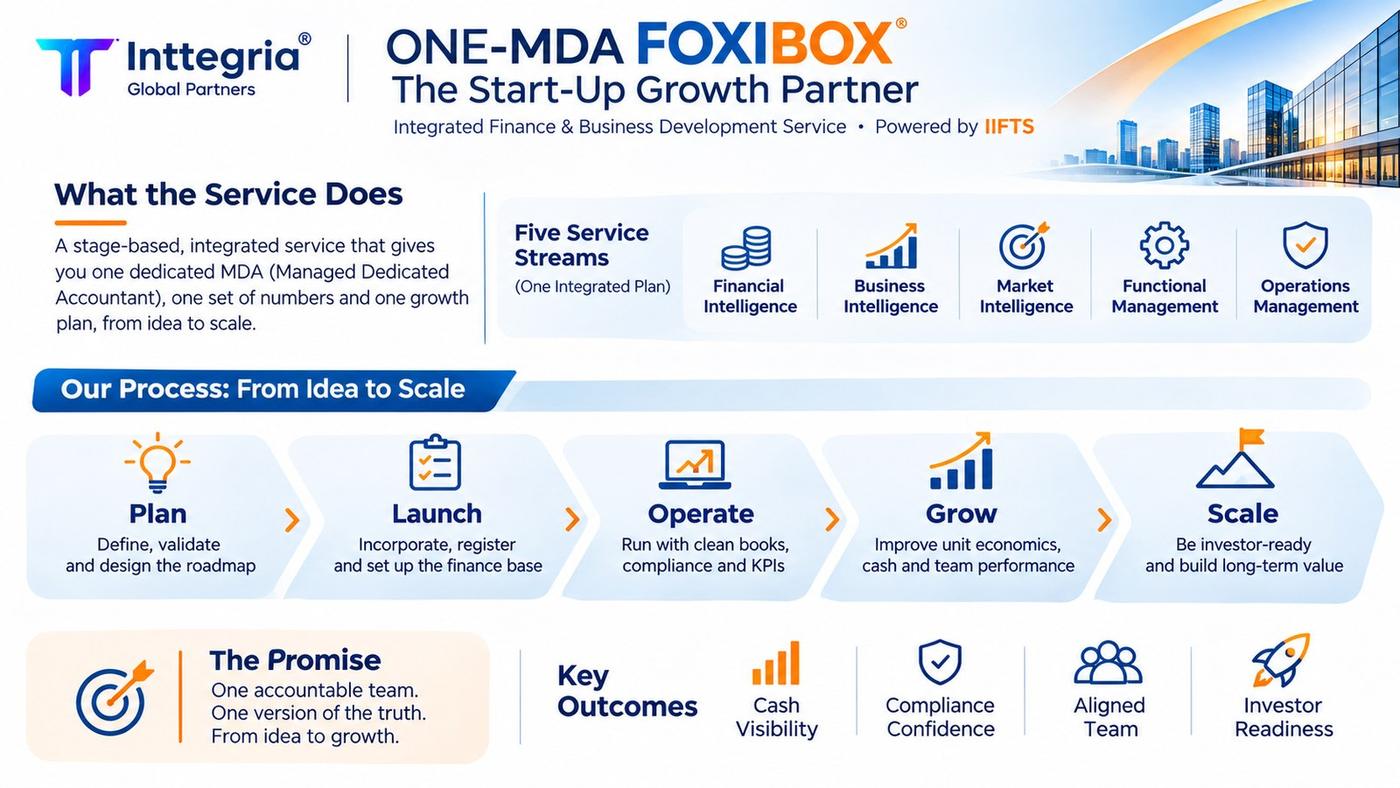
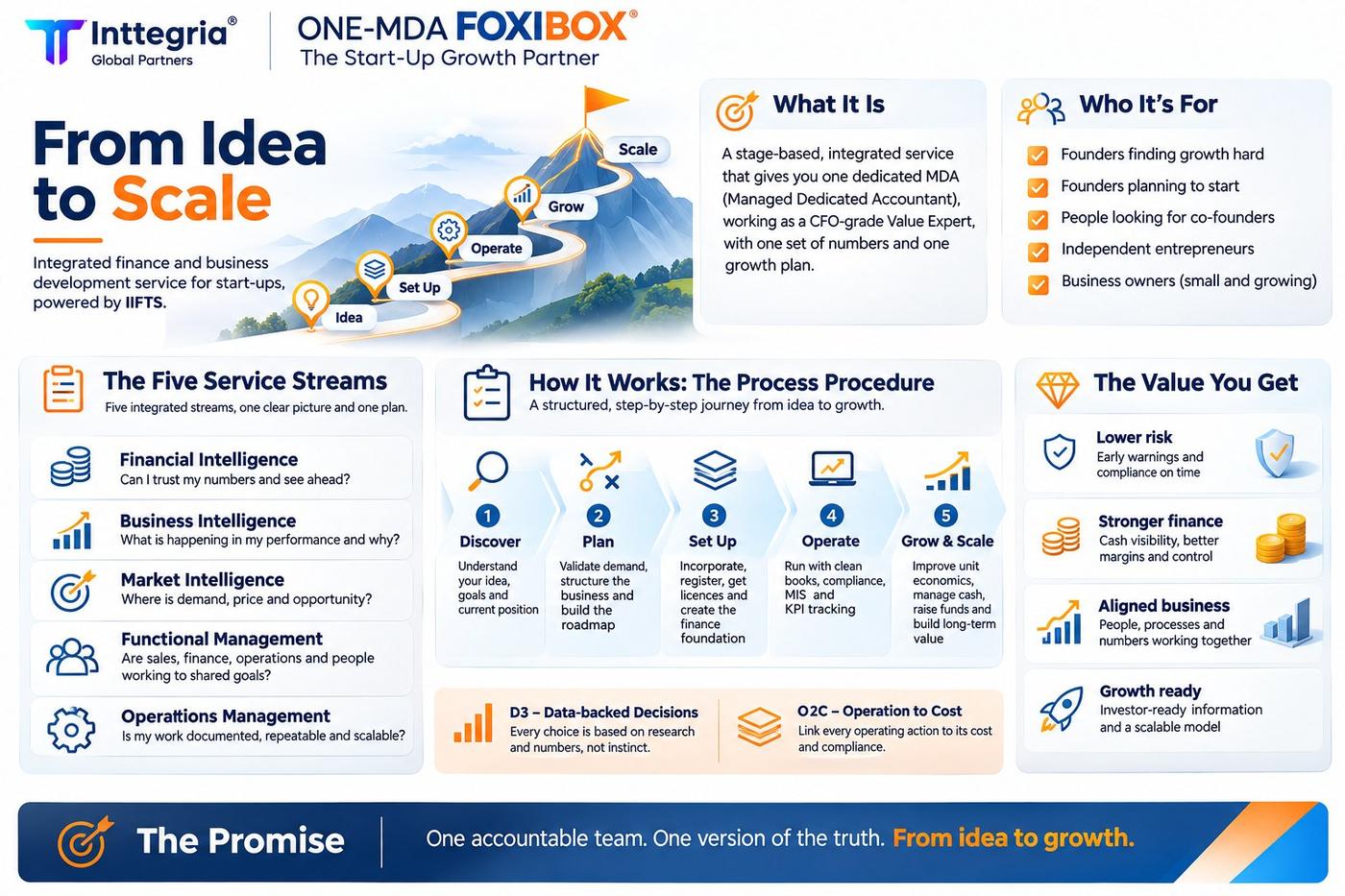
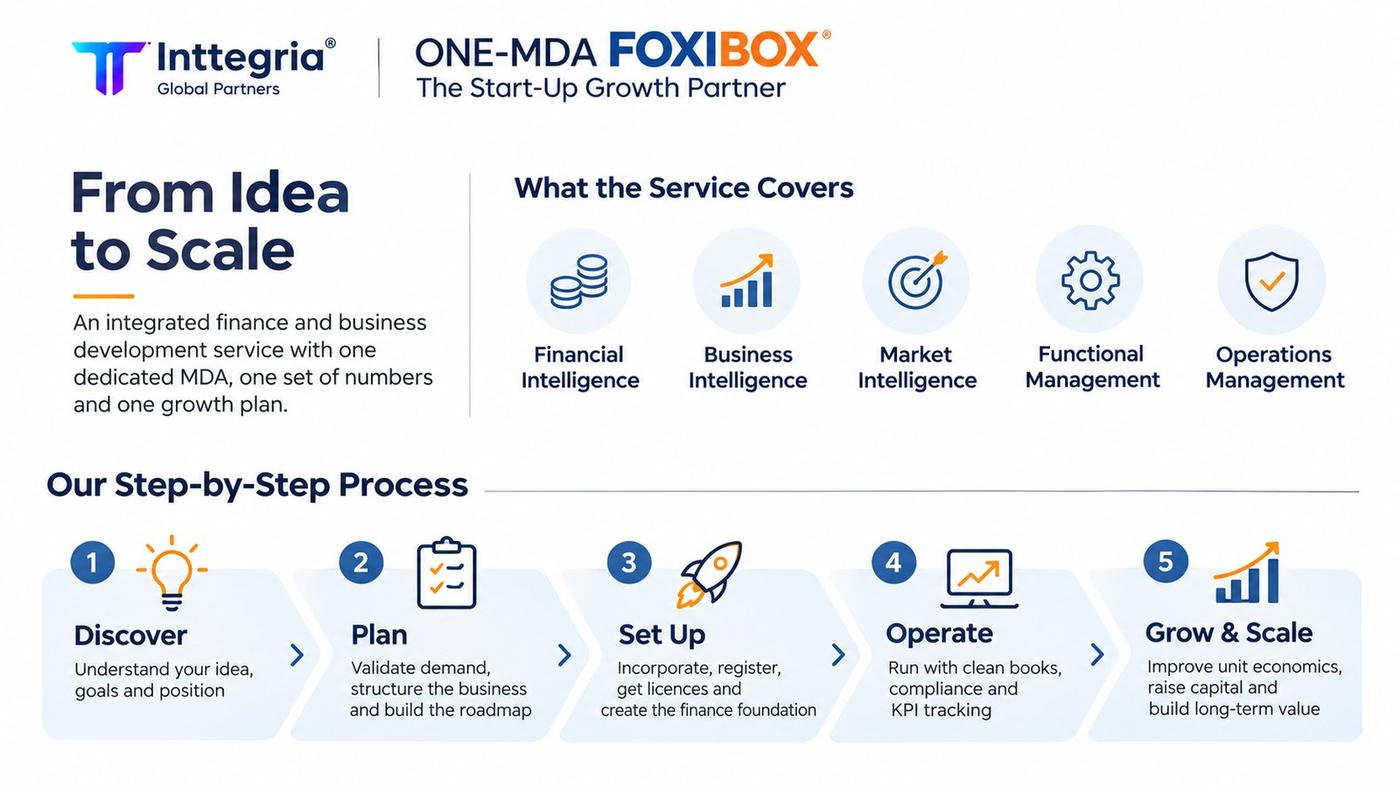
Start-Up X is a stage-based service that takes a founder from first idea to a scalable, compliant, investor-ready business, with one dedicated accountant (MDA) and one set of numbers throughout.
Promise: One accountable team. One version of the truth. From idea to growth.
The core idea
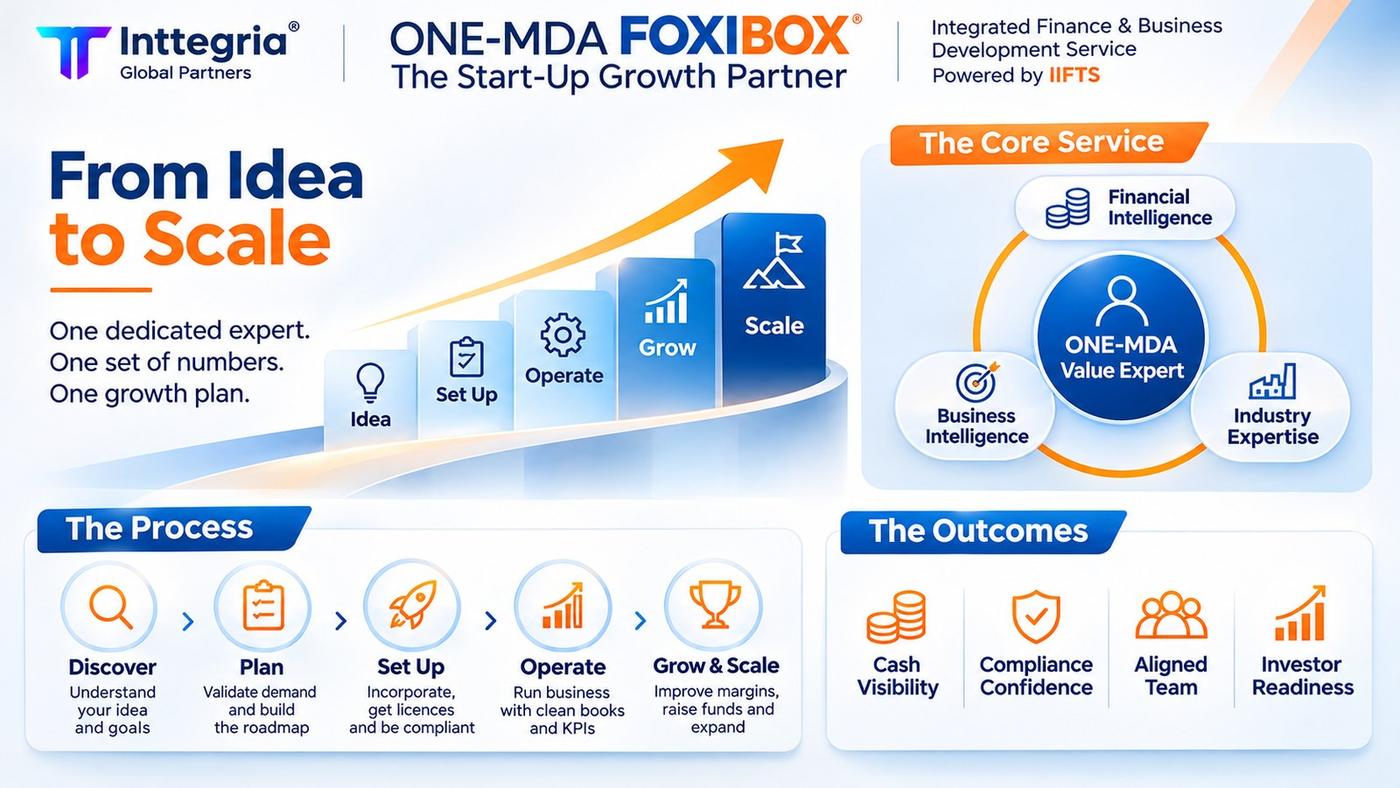
Three intelligences around one MDA
The framework places the MDA at the centre of three intelligences. Each answers a founder's question.
| Intelligence | The founder's question | What the MDA does |
|---|---|---|
| Finance intelligence | Can I trust my numbers and see ahead? | Books, forecasts, budgets, cash, tax planning |
| Business intelligence | Is my work organised and repeatable? | Operating model, processes, KPIs, shared scoreboard |
| Industry expertise | Does my finance fit how my industry earns and spends? | Cost structure, margin drivers, licences, regulation by sector |
Two ways of working
The framework uses two ways of working. Both end at the same place.
- Finance-centric: Planning, Roadmap and Finance. Money decisions lead.
- Functional-centric: Objective, Work Together and Function. Teams run on shared goals.
Start-Up X starts finance-centric (Phase 1) and becomes functional-centric as the business grows (Phase 2).
Three change points in a founder's life
- Pre-registration to post-incorporation: from an idea to a legal entity.
- First employee, from Founder to Business Partner (F → B): the founder stops being the only doer.
- Structure to scalable: from a working business to one that grows without breaking.
Two principles that run through the framework
- D3, data-backed decisions: every choice is based on research and numbers, not instinct.
- O2C, Operation to Cost management: every operating action is linked to its cost and its compliance. In the Key Work Point Framework, O2C also means Notice → Law Understanding → Details Filing → Filing On Time. Both readings are used here and kept distinct.
Who this is for
Types of entrepreneurs (the eight founder segments)
| # | Segment | Who they are | Natural entry | Likely route |
|---|---|---|---|---|
| 1 | Launch-Ready | Idea stage, not yet registered | Structure advice before registration | Day-One Setup, then Tier 1 or 2 |
| 2 | Day-One Setup | Registered in the last 0 to 6 months | Tier 1 or 2 | Tier 2 as revenue starts |
| 3 | Operate & Comply | Revenue coming in, small team | Tier 2 | Tier 3 when cash and decisions need attention |
| 4 | Scale & Fund | Growing fast or raising money | Tier 3 (D-AOX) | Tier 4 when operations become the bottleneck |
| 5 | Independent Entrepreneurs | Freelancers, consultants, solo founders | Light Tier 1 or 2 | Tier 2, or a company later |
| 6 | Company That Needs a Push | Registered, stuck or behind on compliance | Clean-up project, then Tier 2 | Tier 3 |
| 7 | Foreign Founders in India | Starting a business in India from abroad | Entry package with partners (FEMA, incorporation), then Tier 2 | Tier 3 |
| 8 | Marketplace & Small Sellers | Amazon, Flipkart and online sellers | Tier 1 or 2 with payout reconciliation | Tier 3 as volume grows |
Types of business structure
Captured as a separate field from industry, as the framework requires.
| Business type | Governing law | Note for the founder |
|---|---|---|
| Sole Proprietorship | No incorporation statute; licences (GST, MSME, Shops & Establishments) | Simplest, no ROC filings |
| Partnership Firm | Indian Partnership Act, 1932 | No ROC; registration optional but helps enforceability |
| LLP | LLP Act, 2008 | Annual LLP filings |
| One Person Company | Companies Act, 2013 | Reduced-compliance company |
| Private Limited | Companies Act, 2013 | Full ROC regime; the usual choice for funding |
| Public Limited | Companies Act, 2013 | Enhanced disclosure |
| Section 8 / Trust / Society | Companies Act s.8 or trust law | 12A, 80G and FCRA layer on top |
| Nidhi Company | Companies Act with Nidhi Rules | Deposit-taking compliance layer |
| Indian subsidiary of a foreign entity | Companies Act plus FEMA and RBI | Extra reporting |
Types of industry
Industry decides which sector laws and licences apply, whatever the legal form.
| Industry | Typical sector touchpoints |
|---|---|
| Manufacturing | Factories Act, pollution consents, inventory and cost accounting |
| Trading and distribution | GST depth, inventory, working capital |
| Services and IT | Export of services, LUT, subscription revenue |
| Food and beverage | FSSAI licence and annual return |
| E-commerce and marketplace sellers | GST TCS, Section 194-O, payout reconciliation |
| Financial services | RBI and SEBI-adjacent obligations |
| Healthcare | Clinical and professional registrations |
| NGO / social sector | 12A, 80G, FCRA, grant utilisation |
| Import-export | IEC, AD Code, customs |
Statutory rates, thresholds and dates change; confirm them with a qualified professional before you act.
How it works: two phases, one MDA
Phase 1 · Foundation: idea stage to incorporation
Scratch start-up ideation to incorporation. Six workstreams, each with its outcome.
| Workstream | What happens | Outcome for the founder |
|---|---|---|
| 1. RnD on industry and founder objective | Research the industry and capture what the founder wants. Decisions are data-backed (D3) | A decision brief the founder can defend |
| 2. Planning incorporation | A business-type-based business plan. Entity, state and industry are read together | Right structure, with two rejected alternatives and reasons |
| 3. Finance and price management | Link operations to cost (O2C). | Unit economics and a pricing logic |
| 4. Capital and investment | Capital need, budget, expense, price and sales planned as one loop | A first budget and funding view |
| 5. Incorporation to compliance | Incorporate, then agreements, licences, legal, IP and trademark, then accounts | A statutory kit and a populated first-year calendar |
| 6. Accounts set-up | Chart of accounts, data room, books opened on day one | Books ready before the first transaction |
Parallel MDA responsibilities (run from day one, alongside Phase 1)
- Accounts and bookkeeping: financial forecasting, building the finance management system, compliance calendar and MIS planning.
- Accountable expert, real-time measure: performance tracking, KPI generation and tracking.
- MDA-Partner: the MDA brings in licensed partners (CA, CS, legal) so one person fronts the whole expert panel.
Phase 2 · Post-incorporation: intelligence and integration
The foundation then extends into strategy, operating model and functions, in four layers of intelligence.
| Layer | Focus | FOXIBOX stage it maps to |
|---|---|---|
| I. Business intelligence | Strategy and operating model | Stage 2: operations management |
| II. Market intelligence | Customers, pricing, market opportunity | Stage 4: business growth |
| III. Financial intelligence | Numbers you trust, forecasts, cash | Stage 1: FOX |
| IV. Functional and operations management | Finance, sales, operations, marketing and IT on shared KPIs | Stage 3: functional management |
How Start-Up X maps to the four ONE-MDA tiers
| Tier | Name | Start-Up X moment |
|---|---|---|
| 1st MDA | Essential Bookkeeping | Day-one books for the smallest businesses |
| 2nd MDA | Accounting and Bookkeeping plus Compliance Filing | First revenue; named accountant, MIS, GST, TDS, ITR |
| 3rd MDA | D-AOX | Decisions, controls, forecasts, lender-ready financials |
| 4th MDA | FOXIBOX | Finance joined to operations and functions; CFO-grade advisory |
Each tier contains the one below it, so the founder changes tier, not provider.
Key features
- A named accountant with a published back-up, a reviewer and a delivery lead.
- One data room: records, reports and filing acknowledgements, with books kept up to date as documents arrive.
- Industry first: the accountant learns your industry before applying any template.
- Compliance calendar populated at incorporation, every due date owned and tracked.
- Two-level review on every deliverable, and your recorded approval before any filing.
- Decision packs, not data dumps: what changed, why, and what to do next.
- Founder-to-scale path: four tiers on one data foundation.
- Expert panel across legal, CA, CS and regulatory work through licensed partners.
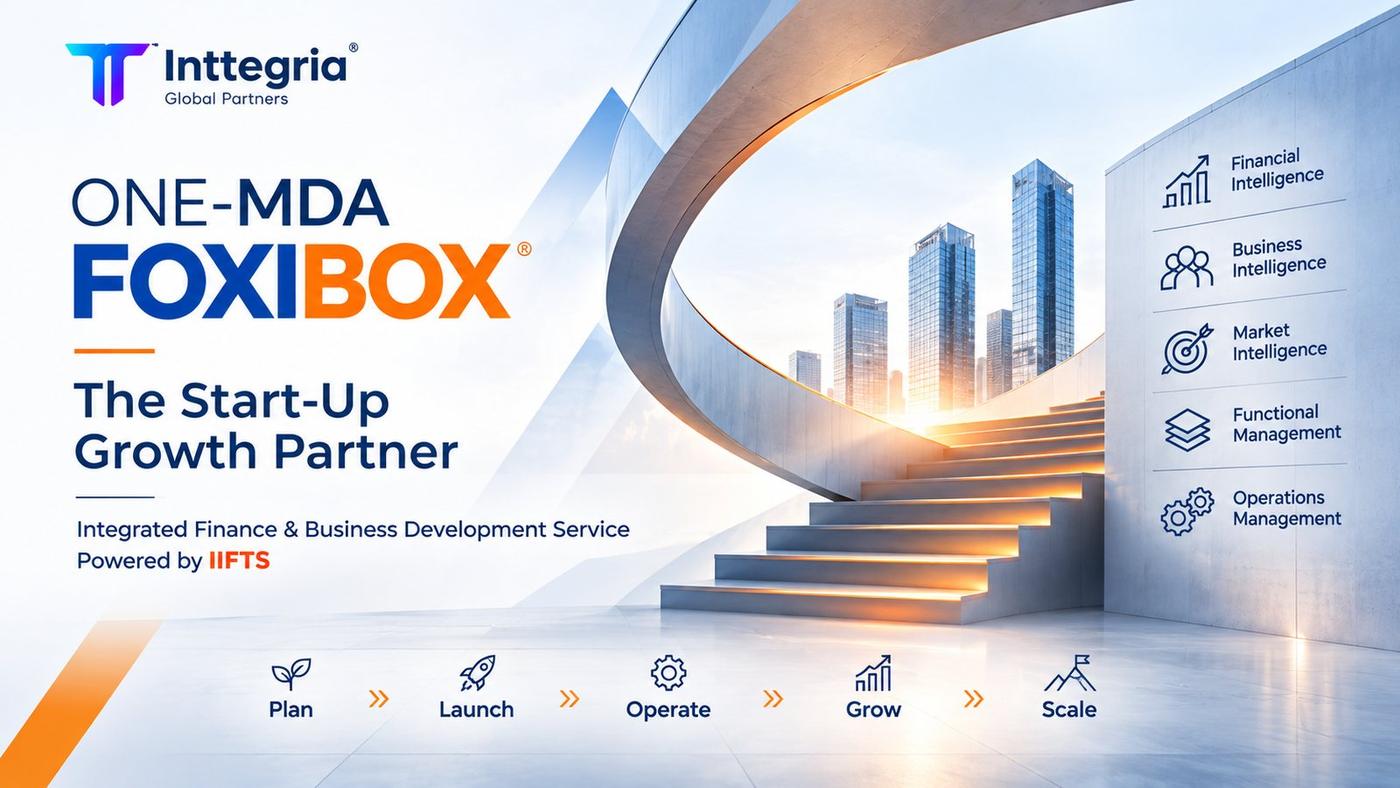
- IIFTS engine: Identify, Inspect, Flag, Track, Strengthen on every engagement.
Key Work Points (KWP)
Every Start-Up X engagement runs the eight-point universal spine. A Key Work Point has one named owner, produces evidence, has a pass/fail check by someone else, and has a real consequence if it fails.
| KWP | Name | Start-Up X application | Evidence |
|---|---|---|---|
| 0 | Intake and eligibility lock | Confirm founder segment, service fit, scope and fee. For registration, industry, state and business type are all captured | Signed scope note |
| 1 | Business understanding | Industry type and business type as two separate fields; founder objective; existing records | Business profile in IIFTS |
| 2 | Requisition and verification | One-time document list, verified before use | Requisition list with status |
| 3 | Standard procedure execution | The Phase 1 workstreams or the tier procedure, one branch per industry and business-type combination | Primary work product |
| 4 | Maker-checker control | Independent review; fail goes back, no conditional pass | Signed checker record |
| 5 | Submission and release | File or release ahead of the buffered date | Acknowledgement, SRN, ARN, challan |
| 6 | Client handover and explanation | Evidence pack plus a plain-language explanation | Handover pack, dated note |
| 7 | Feedback into IIFTS and next cycle | Deposit figures, set next trigger, score the engagement | IIFTS update, next trigger |
Hold conditions stop work (and the founder is told the same working day): eligibility not established, incomplete verified input, checker fail, unresolved prior-period issue.
A service filed but not explained (KWP 6) or not fed back (KWP 7) is recorded as incomplete.
Standard Process Structure (the container)
The same for every service, every client, every month.
- Trigger: every engagement opens with a defined trigger, owner and due date.
- Track: the live engagement register shows current state without asking the doer.
- Check: every completion is checked by someone other than the doer.
- Evidence: every work point produces a named artefact a third party can find.
- Close: closure is recorded with evidence, retained to a fixed schedule.
- Loop: output feeds IIFTS and sets the next trigger.
Control chain: real-time control, to reduce errors, to avoid risk, to regulatory standing.
Buffers: internal dates sit ahead of statutory dates. File on the buffer date, never on the due date.
Standard Procedure (the content)
One documented procedure per service line, one fixed depth, deviations only in writing with reason and approver.
Start-Up X onboarding SOP
Typical timings for the first 45 days. Your written scope confirms the exact dates.
| Step | Days | Action | Owner | Control and evidence |
|---|---|---|---|---|
| 1 | 1 to 3 | Free diagnostic: segment, stage, gaps. Fix scope and fee | MDA lead | Signed scope note |
| 2 | 3 to 7 | Capture industry type, business type, state, founder objective, finance pattern | MDA | Business profile |
| 3 | 7 to 14 | Structure recommendation, name strategy, founder and capital mapping | MDA with legal and CS partner | Written recommendation with two rejected options; cap table signed by founders |
| 4 | 14 to 30 | Build the plan: budget, price and cost logic, funding view, KPI set | MDA | Plan reviewed by checker |
| 5 | 20 to 45 | Incorporation filing and tracking; first licences mapped by industry and state | Licensed partner, MDA coordinates | SRN tracked to approval |
| 6 | 30 to 45 | Set up data room, chart of accounts, opening balances | MDA | Classification rules locked |
| 7 | 45 | Handover: statutory kit and first-year calendar with dates populated | MDA | Handover pack acknowledged |
| 8 | 45 onward | Monthly cycle begins, tier chosen to fit | MDA | Signed closure checklist |
The monthly rhythm
A typical month. Your written scope confirms the exact dates.
| When | What happens | Founder's part |
|---|---|---|
| Working days 1 to 3 | Month cut-off and pending items | Respond within three working days |
| Working days 3 to 8 | Reconciliation, GST and TDS working | Answer queries |
| Working days 8 to 9 | Returns ready for approval | Approve or comment |
| Working days 9 to 12 | Filing via licensed professional; acknowledgements shared | None |
| By working day 15 | MIS or decision pack and review call | Attend and decide |
Cadence beyond the month: a weekly 30-minute operating review (Tiers 3 and 4), a quarterly strategy and governance review, and an annual plan.
Rules that never bend
- Written scope only; nothing is done on verbal instruction.
- Depth is fixed by the specification, not by the fee. Launch pricing carries the same depth as list pricing.
- Same-day disclosure of any hold condition, notice, or error we find.
- The silence rule: no client goes a full cycle without hearing from us, even in a nil month.
Responsibilities: Founder, MDA, and together
The founder owns
- The objective, the risk appetite and the final decision.
- Timely, complete documents (response within three working days of cut-off).
- Reporting corporate events as they are decided (new director, share issue, new premises, new hire).
- Approving every filing and reading the monthly pack.
- Attending the monthly review call.
The MDA owns
- Books, reconciliations, closing and MIS, promptly after documents arrive (service levels are set in your written scope).
- The compliance calendar and every deadline, raised before the founder asks.
- Preparing returns and coordinating filing through licensed professionals.
- Industry-first set-up, KPI generation and tracking, forecasts and variance commentary.
- Proactive communication of notices, mismatches and cash risks.
- A named back-up, a reviewer, and an escalation path.
Together
| Shared responsibility | How it works |
|---|---|
| Decisions | MDA frames options with trade-offs; founder decides; the decision is logged |
| Plan and budget | Built jointly, reviewed quarterly against actuals |
| KPIs | Agreed together, tracked by the MDA, acted on by the founder |
| Implementation | MDA tracks whether decisions were carried out; founder owns the action |
| Approvals | No filing without the founder's recorded approval |
Responsibility grid
| Activity | Founder | MDA | Licensed partner |
|---|---|---|---|
| Business objective | Decides | Advises | n/a |
| Structure choice | Decides | Recommends | Legal / CS input |
| Incorporation filing | Approves | Coordinates | Files and signs |
| Bookkeeping and close | Provides documents | Performs | n/a |
| GST, TDS, ITR | Approves | Prepares | Files or certifies where required |
| Audit and certification | Provides access | Coordinates | Signs |
| MIS and decision pack | Reads, decides | Prepares | n/a |

Integration: how INTTEGRIA services work together
The KWP Framework requires every service to deposit its output into IIFTS, so a one-off registration also feeds the founder's financial picture.
| Founder moment | Service family used | What it feeds into IIFTS |
|---|---|---|
| Choose structure | Startup and Business Registration | Entity, shareholding, capital |
| Get licensed | Licences and Registrations | Licence list, renewal dates |
| Stay compliant with ROC | Secretarial and ROC | Event log, registers, calendar |
| Sell and buy | GST Services | ITC position, vendor defaults |
| Keep books | Accounting and Bookkeeping (GDA / D-AOX) | Trial balance, ageing, forecast |
| File tax | Direct Tax | Positions, TDS ties, planning notes |
| Hire | Payroll and Labour | Master data, statutory deposits |
| Sign contracts, protect brand | Legal, Documentation and IP | Agreements, trademark renewals |
| Make decisions | Advisory and Virtual CFO (FOX / BOX) | Decision log, projected vs actual |
Cross-functional loop: Identify gaps, Inspect records, Flag exceptions, Track to closure, Strengthen controls. A GST mismatch found by the GST team becomes an alert to the accountant and a line in the founder's cash view.
Regulatory content model. What a founder must file depends on the intersection of industry type and business type, and, for registration, state. KWP 1 captures these fields first; KWP 3 branches on them.
Outcomes and measures
Five success signals, reported monthly:
- The founder stops asking "is it filed?"
- No notice arises from anything we controlled.
- The founder can state their position unaided from our last report.
- Renewal happens without renegotiating value.
- The founder refers us unprompted.

Six-dimension scorecard (each 0 to 5, checked independently): scope, depth, timeline, evidence, intelligence and relationship integrity.
Measures we use: late filings, document-to-ledger days, MIS on time, client confidence score.
What INTTEGRIA does, and what licensed partners do
INTTEGRIA is a data-intelligence and financial-intelligence organisation, not a CA firm. Audit, CA and CS filings and legal opinions are signed and filed by licensed partners.
This document is general service and planning information, not tax or legal advice. Statutory dates, rates and thresholds change; confirm with a qualified professional.
Want a dedicated accountant for your business?
Meet the MDA service, or tell us what you need and we will come back with a plan.