Business Registration in India: Register Right the First Time
Choosing the Right Structure, Preparing the Right Documents and Avoiding Costly Mistakes
Starting a business in India begins with a formal decision: which legal structure will carry your idea? That choice affects your personal liability, your tax and compliance workload, your ability to raise money and even how banks, clients and investors see you.
At Inttegria, we treat registration as the foundation of a business, not a certificate to be collected. This guide covers what founders should know before they file, and the points that are most often missed.
What Company Registration Really Means
Registering a company means recording it with the Ministry of Corporate Affairs (MCA). Once incorporated, the company is a separate legal entity. It can own property, sign contracts, open bank accounts, employ people and sue or be sued in its own name.
The practical benefit is limited liability: in most cases, your personal savings and property are protected from the company's debts. Limited liability is not absolute, though. Directors can still be held personally responsible for things like fraud, personal guarantees given to lenders, and certain statutory defaults.
Do You Actually Need to Register?
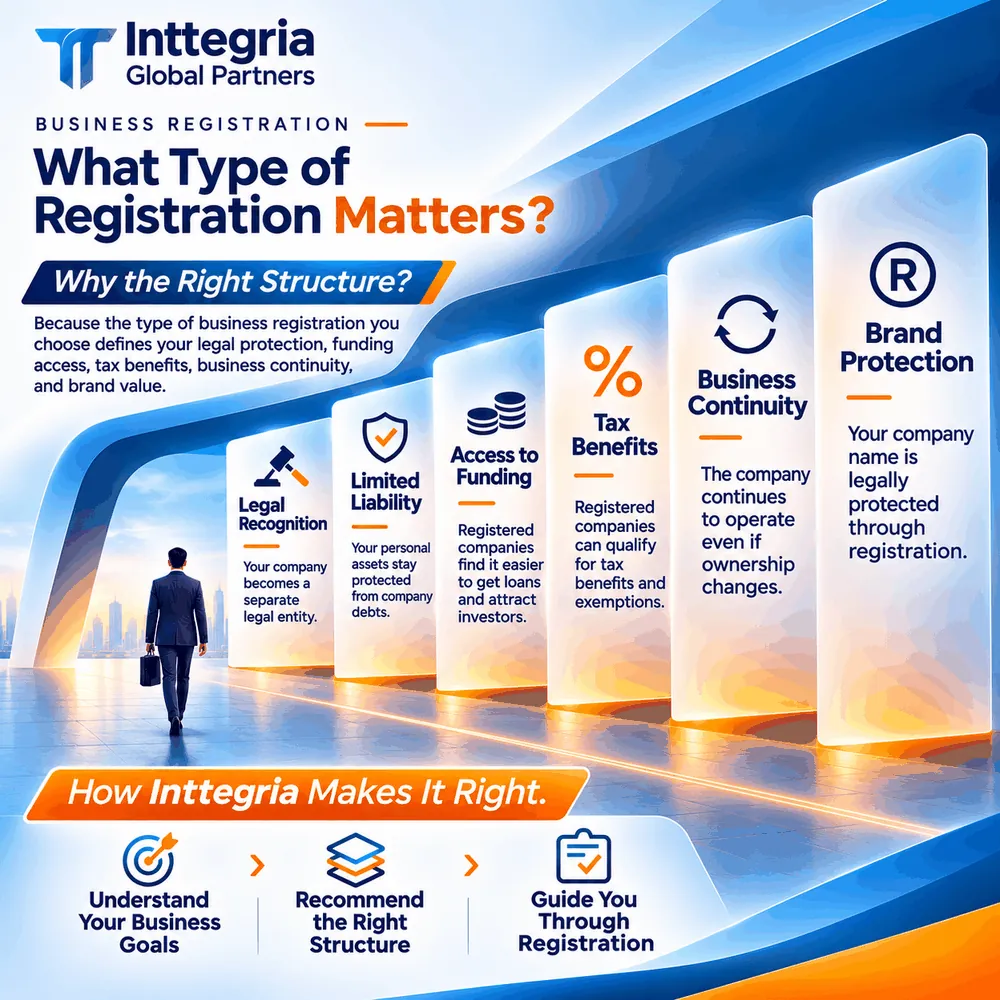
Registration makes sense if you want:
- Limited liability protection for personal assets
- To raise money from investors or apply for larger business loans
- A legally protected brand identity
- A structure that continues even when ownership changes
- Credibility with clients, suppliers and government bodies
A small, single-owner trade can run as a sole proprietorship, which is not a separate corporate entity. It still needs local licences and tax registrations, and the owner carries unlimited personal liability.
Business Structures at a Glance
| Structure | Minimum people | Liability | Governed by | Typically suits |
|---|---|---|---|---|
| Sole Proprietorship | One individual | Unlimited, personal | No separate entity; local licences | Freelancers, very small trades |
| Partnership Firm | Two (maximum fifty) partners | Unlimited, shared | Partnership agreement | Small groups running a joint trade |
| One Person Company (OPC) | One director and one member, who must be an Indian resident | Limited | Companies Act, 2013 | Solo founders wanting limited liability |
| Limited Liability Partnership (LLP) | At least two partners | Limited | LLP Act, 2008 | Professional and service firms |
| Private Limited Company | Two directors and two shareholders (up to 200 shareholders) | Limited | Companies Act, 2013 | Startups expecting outside investment |
| Public Limited Company | Three directors and seven shareholders | Limited | Companies Act, 2013 | Larger firms raising capital from the public |
Inttegria's practical view:
- OPC gives solo founders protection without the full weight of a private company, but it has conversion triggers and residency conditions that must be understood up front.
- LLP works well for consultants, agencies and professional practices, with lighter compliance. It is generally less familiar to equity investors.
- Private Limited Company is the structure investors know best. If you expect to issue shares, give ESOPs or raise funding, it is usually the more natural fit.
The right answer always depends on your plans, so we recommend a structure only after understanding the business, the founders and the funding outlook.
How Incorporation Works: The Technical Flow
For companies, the process runs through the MCA portal and follows a defined sequence:
- Digital Signature Certificates (DSC) for the proposed directors and subscribers.
- Director Identification Number (DIN) for each director.
- Name reservation and application through the integrated SPICe+ form, which also carries the company name request, the registered office details and the capital structure.
- Memorandum and Articles of Association (MoA and AoA) drafted to match the actual business, not copied from a generic template.
- Optional linked services through the integrated form, such as PAN, TAN, GSTIN, EPFO and ESIC registration, and bank account opening, depending on eligibility.
- Certificate of Incorporation issued by the Registrar once the application is approved.
What looks like a form-filling exercise is really a set of interlinked decisions: the object clause, the authorised and paid-up capital, the business activity code, the registered office and the director roles. Mistakes here are possible to correct later, but correction costs time, filing fees and sometimes stamp duty.
Documents You Will Need
For Directors or Partners (Pvt Ltd, LLP, OPC)
- Identity proof: PAN card (mandatory for Indian nationals) or passport (mandatory for foreign nationals)
- Address proof: Voter ID, passport, driving licence or Aadhaar card
- Residence proof: A recent bank statement, electricity bill or telephone bill, dated within the last two months and showing the exact name on the identity proof
- Passport-size photographs
For the Registered Office
- Proof of ownership or tenancy: Rent agreement or lease deed
- No Objection Certificate (NOC): A signed declaration from the owner allowing the business to use the address
- Utility bill: Recent electricity, gas or water bill, dated within the last two months
For a Sole Proprietorship
No corporate registration is involved. The focus is on a bank account and a local identity:
- Owner's PAN and Aadhaar
- Two business proofs, such as a GST certificate, Shop and Establishment licence, MSME (Udyam) registration or a professional licence
Inttegria tip: Names must match across every document, character for character. A middle-name initial that appears on one document and not another is one of the most common reasons for queries and delays.
Post-Incorporation Deadlines Founders Often Miss
There is no fixed deadline to start a business. But once the certificate is issued, statutory clocks begin.
| Action | Deadline |
|---|---|
| Open a current bank account | Right after incorporation, to deposit initial share capital (a practical step, not a legal deadline) |
| Appoint the first auditor | Within 30 days of incorporation, through a board meeting |
| Issue share certificates to initial subscribers | Within 60 days of incorporation |
| File Commencement of Business (Form INC- 20A) | Within 180 days of incorporation, and before starting business operations |
| GST registration | Within 30 days of becoming liable. Liability generally begins once turnover crosses ₹20 lakh for services or ₹40 lakh for goods (₹10 lakh and ₹20 lakh in special category states) |
Beyond these first-year tasks, companies carry recurring annual obligations: annual financial statement and annual return filings with the MCA, income tax returns, auditor-related filings and director KYC. A compliance calendar built in the first month saves penalties for years.
The Pre-Registration Checklist
Before you file anything, confirm these points:
- Name: Is it unique, available and free from trademark conflict? A name approved by the MCA is not the same as a name that is safe from a trademark claim.
- Objects: Does the object clause cover everything you may do in the next five years, including activities you plan to add?
- Capital: Is the authorised capital sensible? It affects government fees and stamp duty.
- Registered office: Do you have a valid address proof and owner NOC?
- Directors and shareholders: Are roles, shareholding and any founder agreements clear?
- Business activity code: Does it reflect what you will actually do? It influences many later filings.
- Industry permissions: Does your sector need a licence before or soon after you begin? (See Part 2.)
Why Incomplete Registration Costs More Than It Saves
Many founders choose a registration provider on price alone. Most providers do honest work. But when the engagement is limited to "get the certificate", the founder is often left with gaps that surface months later, usually at the worst time: a funding round, a bank audit, a notice or a client's vendor verification.
These are the gaps we most often see when we review businesses registered elsewhere:
- Generic object clauses that do not cover the real business, forcing an amendment later
- Wrong or default activity codes that create mismatches in GST and annual filings
- No post-incorporation follow-through: first auditor, share certificates and INC-20A left unaddressed
- Missed tax and labour registrations that the business model required from day one
- Document name mismatches that go unresolved until a bank or portal rejects them
- No compliance calendar, so annual filings are discovered only when a late fee arrives
- Unclear fees, where the quoted price excludes government fees, stamp duty or professional charges
- No handover: founders are not given complete soft copies, registers or a clear list of what was and wasn't done

The Inttegria Approach
We do not treat registration as a one-time transaction. Our process is organised end to end:
- Discovery: We understand your business, founders and funding plans.
- Structure recommendation: We explain the options and the trade-offs in plain language.
- Brand name research: A research-based name report before you commit to a name.
- Preparation and filing: Document verification, drafting and filing with checks at each stage.
- Tracking: We follow the application through queries and approval.
- First-year set-up: Auditor appointment, share certificates, INC-20A, bank and tax registrations.
- Compliance calendar: A dated schedule of what is due and when.
- Complete handover: Every document, register and filing receipt organised for you.
Founders who prefer to manage the process themselves can still use the timelines and checklists in this guide as a reference.
Continue to Part 2 for industry-wise registrations, licences and compliance.
This guide is general information, not legal or tax advice. Rules, thresholds, fees and forms change and state requirements differ, so confirm current requirements for your case before filing.
Want a dedicated accountant for your business?
Meet the MDA service, or tell us what you need and we will come back with a plan.