Missed a Filing Deadline? What Every Indian Business Owner Must Know Before Filing (and Before Hiring Anyone)
Most founders learn about filings the hard way: a notice arrives, a bank asks for proof, or an investor's due diligence team finds a gap. By then, the late fee is the smallest part of the problem.
This guide explains what business filings are, how they are grouped, what owners in different businesses and industries must be clear about, and where things usually go wrong. At the end, we show how Inttegria Global Partners approaches filings with One-MDA and its O2C report.
What are business filings, and why do they matter?
Business filings are the returns, forms and statements a business submits to government departments and regulators. They record your finances, ownership, management and tax position. Every filing becomes part of your official compliance history, and that history is what banks, investors, buyers and tax officers read about you.
Timely filing protects you in four ways: legal compliance, credibility with lenders and investors, financial transparency, and protection from late fees, interest and penalties.
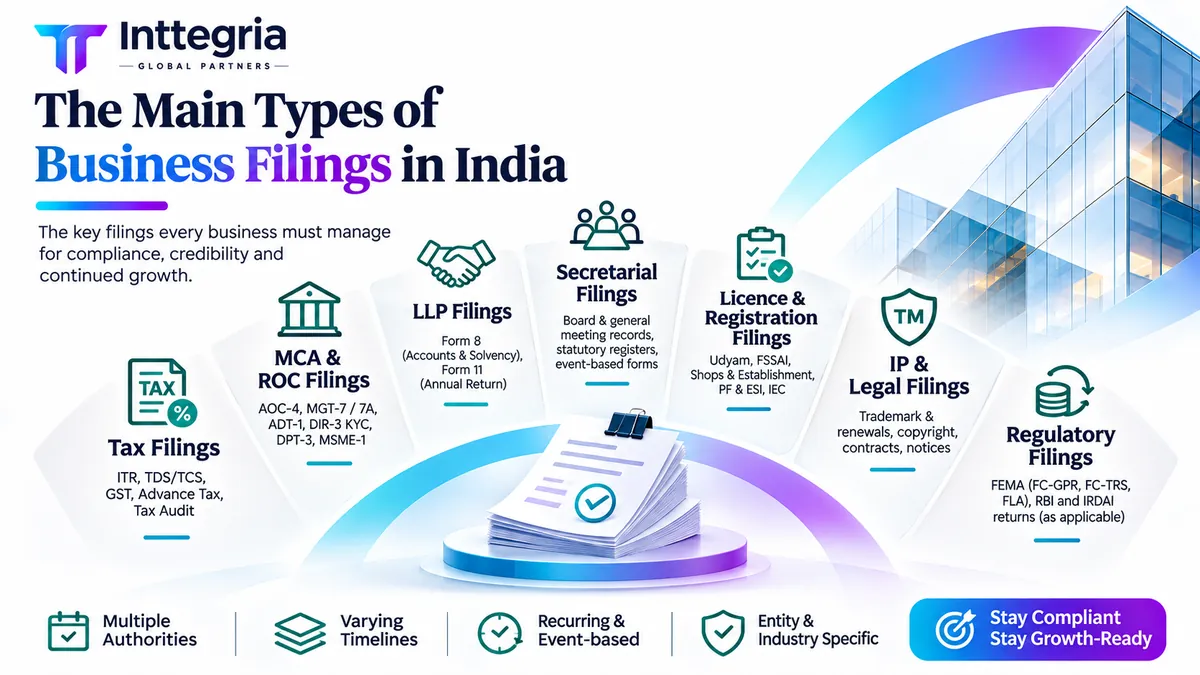
The main types of business filings in India
| Group | Examples | Rhythm |
|---|---|---|
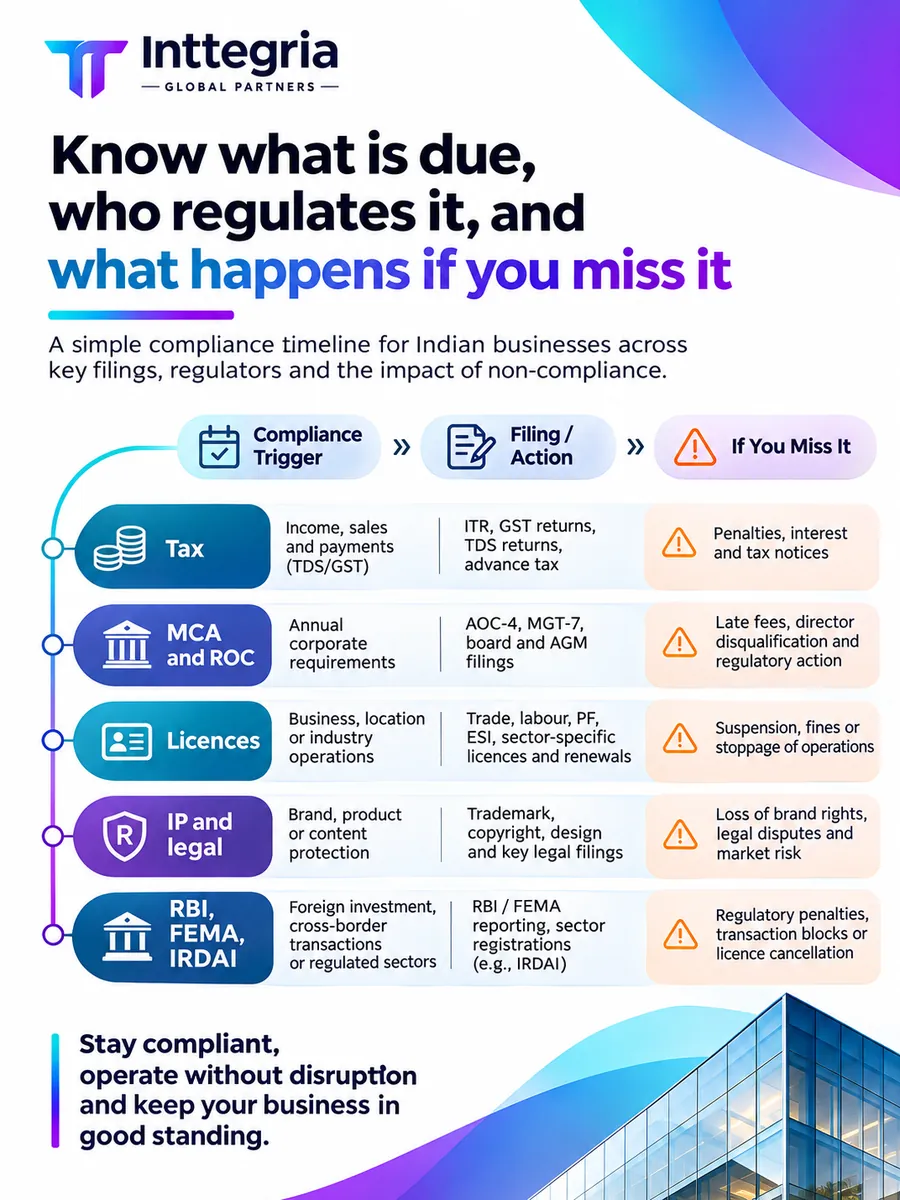
| Tax filings | Income tax return filing, TDS and TCS returns, GST returns, advance tax, tax audit | Monthly, quarterly, annual |
| MCA and ROC filings | AOC-4, MGT-7 or MGT-7A, ADT-1, DIR-3 KYC, DPT-3, MSME-1 | Annual and half-yearly |
| LLP filings | Form 11 (annual return), Form 8 (statement of account and solvency) | Annual |
| Secretarial filings | Board and general meeting records, registers, event forms such as director or address changes | Annual and event-based |
| Licence and registration filings | Udyam, FSSAI, Shops and Establishment, PF and ESI, IEC | Renewal and event-based |
| IP and legal filings | Trademark applications and renewals, copyright, contracts, notices | Event-based and renewal |
| Regulatory filings | FEMA returns (FC-GPR, FC-TRS, FLA), RBI and IRDAI returns where applicable | Event-based and annual |
For a service-by-service list with regulators and triggers, see the India filings guide.
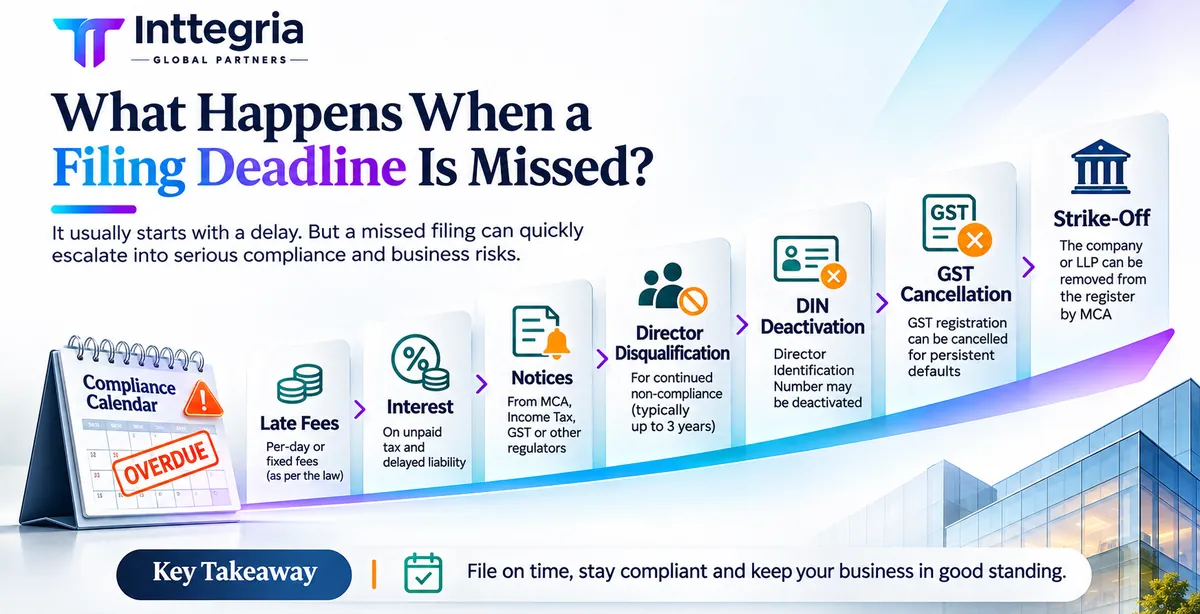
What happens when a deadline is missed
- ROC annual filing: AOC-4 is due within 30 days of the AGM and MGT-7 or MGT-7A within 60 days. Late filing generally attracts ₹100 per day per form, plus possible penalties under Sections 92 and 137 of the Companies Act, 2013.
- Income tax return filing: Late filing fee of ₹1,000 or ₹5,000 under Section 234F (1961 Act), plus 1% monthly interest on unpaid tax. From 1 April 2026 the Income-tax Act, 2025 applies for tax year 2026-27 onwards, with renumbered sections.
- TDS return filing: ₹200 per day under Section 234E, capped at the TDS amount.
- GST filing: Per-day late fees plus interest on delayed tax. Input tax credit for a financial year must be claimed by the Section 16(4) cutoff, or it is lost.
- LLP annual filing: Late fees on Forms 8 and 11 follow a graded MCA fee schedule that grows with delay. Check the current figure on the MCA fee calculator.
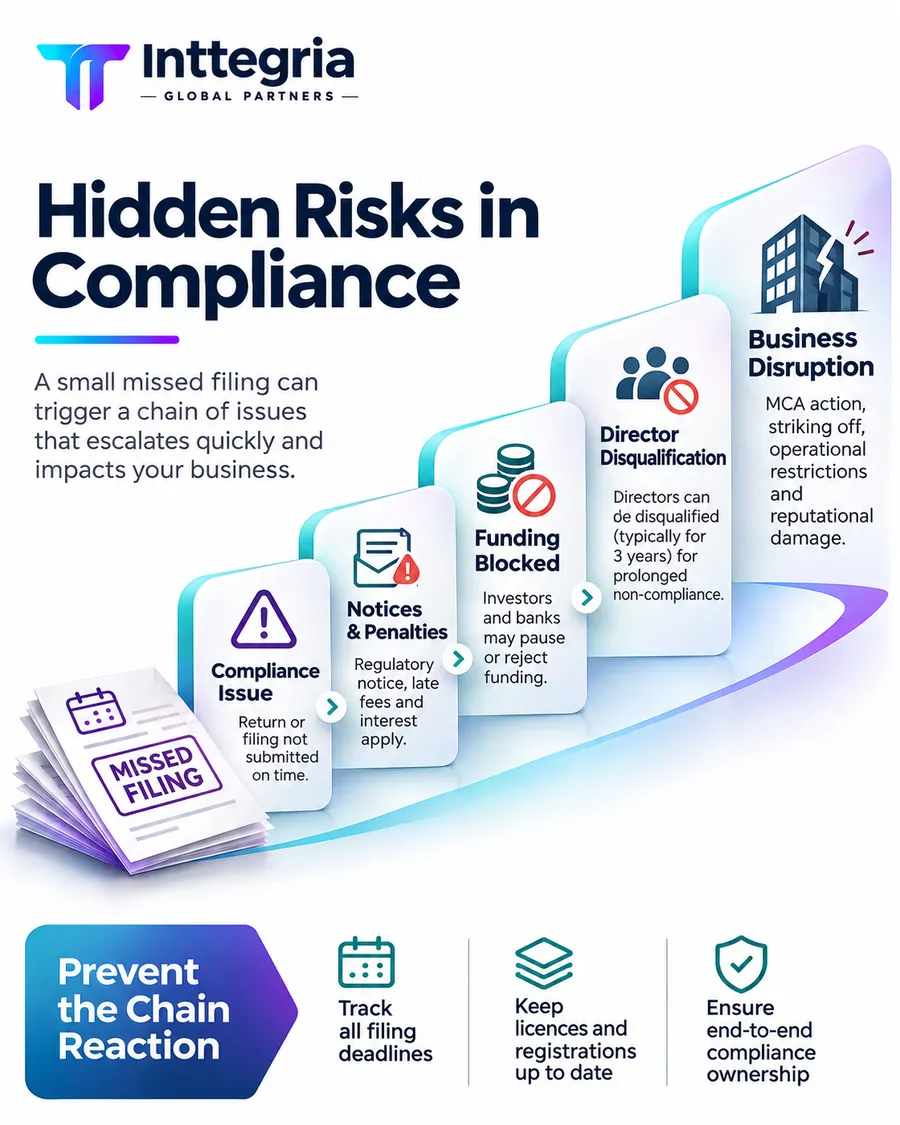
Beyond the fee: continued non-filing can lead to director disqualification, DIN deactivation, GST registration cancellation and strike-off. Penalties vary by law and circumstance, so verify current provisions before you calculate.
What business owners must be clear about before they file
By business structure
- Private limited and OPC: A full annual cycle (AGM, AOC-4, MGT-7, ADT-1, DIR-3 KYC) applies even if the company had no turnover.
- LLP: Form 8 and Form 11 are mandatory every year, plus the income tax return, including for LLPs with no activity.
- Proprietorship and partnership: Fewer ROC items, but GST, TDS, income tax and licences still apply, and liability is unlimited.
- Trusts and NGOs: Annual returns and audit tied to their registrations and exemptions.
By industry
- Exporters and IT services: LUT, foreign remittance paperwork (Forms 15CA and 15CB) and FEMA reporting.
- Food, health and manufacturing: Product and premises licences with their own renewals.
- Fintech, NBFC and insurance intermediaries: RBI or IRDAI authorisations and periodic returns.
- Startups and funded companies: Share allotment filings, FEMA forms for foreign investors and ESOP records.
Ten checks before you file anything
- Books: Are the books updated and reconciled for the period?
- Agreement: Do GST turnover, income tax records and the balance sheet agree?
- Directors: Are directors' KYC and DINs active?
- AGM: Was the AGM held within the statutory window?
- Access: Do you hold your own portal logins, DSC and registered email and mobile?
- Order: Is the filing order right (AOC-4 before MGT-7, Form 8 before Form 11)?
- Signer: Is the signing professional genuine and verifiable by membership number and UDIN?
- Quote: Does your quote separate government fees from professional fees?
- Proof: Will you receive the filed copy and acknowledgement?
- Ownership: Who owns each deadline in your business?
Dates and rules change. Check extensions on the official portals each time, and do not carry last year's calendar forward unreviewed.
How Inttegria helps you file, and keep filing
Inttegria Global Partners offers filing services across income tax returns (individual, business, LLP, private limited, OPC, trust and NGO, revised, belated and ITR-U), TDS returns and corrections, Form 15CA and 15CB support, capital gains and tax planning, assessments and notices, and audit and assurance including statutory, tax and internal audit, due diligence and virtual CFO services.
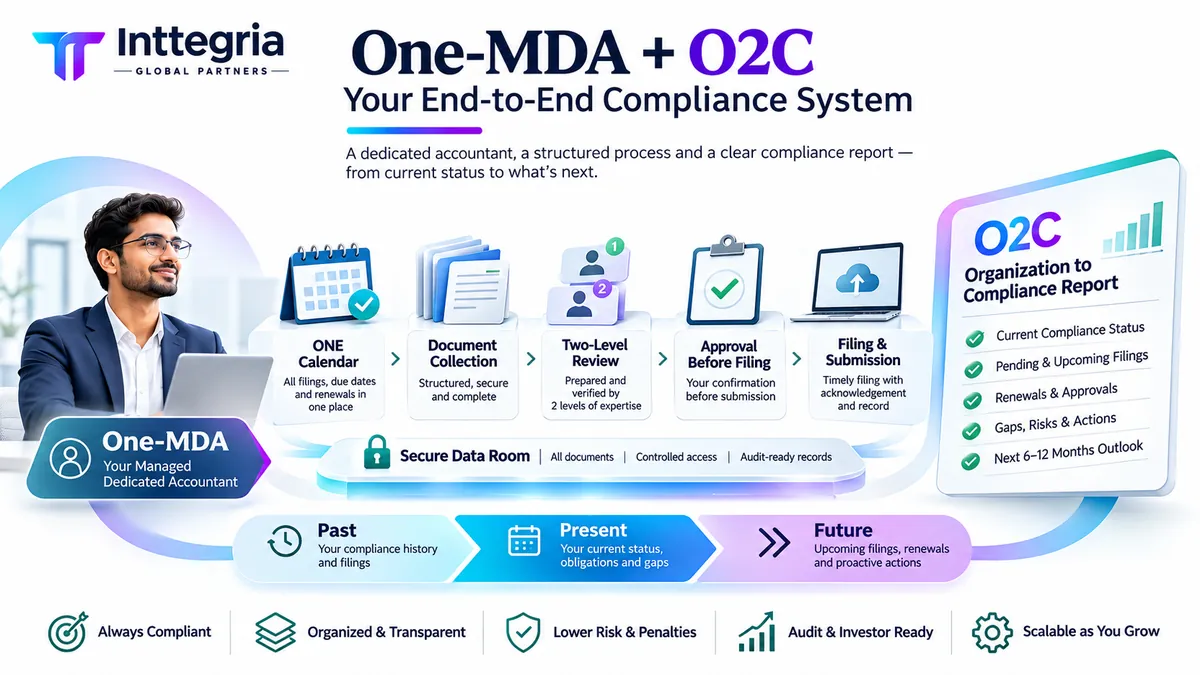
What makes filings dependable is the system around them. One-MDA (Managed Dedicated Accountant) gives you a named accountant who understands your business, tracks every deadline on the ONE Calendar, keeps books organised, coordinates document collection, runs a two-level review and obtains your approval before submission. Acknowledgements and working papers are stored in a secure data room.
Behind One-MDA sits the Inttegria Global Partners (IGP) O2C, the Organization to Compliance report. It consolidates your organisation's compliance and filing position in one place, so you can see what has been done, what is pending and what is coming.
Next in the series: if filings are this connected, why do so many go wrong, and what does an accuracy-first provider look like? Read Part 2: Why Inttegria Exists.
Frequently asked questions
What are the main types of business filings in India?
Tax filings, MCA and ROC filings, LLP filings, secretarial filings, licence and registration filings, IP and legal filings, and regulatory filings such as FEMA, RBI and IRDAI returns.
What happens if I miss an ROC annual filing?
Late fees apply from the due date, and continued non-filing can lead to director disqualification, DIN deactivation and strike-off. Check current fees on the MCA portal.
Do companies with no turnover still have to file?
Yes. A private limited company, OPC or LLP has to complete its annual filings even with no activity.
This article is general information, not legal or tax advice. Dates, extensions and fees change often. Verify current due dates and fees on the official portals or with a qualified CA, CS or lawyer before you act.
Want every deadline tracked for you?
Set up One-MDA for a named accountant and one calendar, or ask for your O2C report to see where you stand today.